People (rightly) get upset if they are a victim of discrimination in employment or in receiving entitlements from government. In large measure this reflects a widespread conviction that the merit principle should be paramount in such matters. Regretfully, merit and purely commercial considerations are often subverted to other agendas.
There is a perception that human rights legislation and its bureaucratic enablers (despite their rhetoric) are major culprits, who often sacrifice merit in favour of promoting the interests of identified minority groups or ignore issues affecting others. The claimed justification is pursuit of concepts of "fairness" and more equal outcomes, even though "progressive" ideology is commonly the dominant consideration. Anti-discrimination advocates commonly argue that their rules prohibiting discrimination, and promoting equity and diversity make commercial sense because avoiding discrimination and inequality enables the most productive people to be selected, especially over the longer term.
I came face to face with this conflict about six months ago at a Christmas dinner, mainly attended by small business owners, in Canberra of all places. A striking feature of the attitude of businesspeople to recruitment was their strict adherence to merit (at least in their minds), as reflected in their personal assessment of the potential contribution of applicants to their business. While businesspeople had their biases (and I suspect nepotism in favour of family members, as part of succession plans, is also an unspoken consideration), these biases seemed to mostly reflect life experiences with individual groups rather than mere prejudice.
Advertisement
A real estate agent, for example, declared that mature women make the best rental managers. He cited ability to multi-task and the stability and judgment of women with some years of experience dealing with people. A jeweller meanwhile observed that (in her experience) gay men tended to make great salespeople in her shop, because of their interest in the product and their empathy with the customer. The list of observations went on.
Most striking of all was the unanimous view that small businesses would be mad to recruit any prospective employee known to be pregnant or likely to soon become so. Even more noticeable was that female small business owners were the most adamant in this view.
The issue is that, while it is against the law to discriminate on the basis of pregnancy (or potential pregnancy), the reality of how legislated rules apply, can make it very unprofitable and inconvenient to take on someone who will shortly go on leave and who you are not subsequently allowed to replace. Eligible parents until recently received up to 26 weeks of government-funded Paid Parental Leave (PPL) at the national minimum wage. This increased to 30 weeks from 1 July 2026.
In addition, "pregnant persons" (sic) have the following additional legal rights:
- Continuation of work during the 6 weeks leading to birth by providing a medical certificate that it is safe to do so, if they choose not to take birth related leave.
- Transfer to a safe job due to illness or risk due to pregnancy for the 6 week period leading up to their due date, or the right to paid leave if no safe job is available.
- The right to return to work after leave.
- For those employed for at least 12 months, the right to take special maternity leave for a pregnancy-related illness or if pregnancy ends because of a miscarriage or still birth.
- For those employed for at least 12 months, the right to take 12 months unpaid parental leave.
- The Sex Discrimination Act 1984 also protects against being treated less favourably than a person in the same work situation who is not pregnant or potentially pregnant.
The bottom line for employers with small numbers of employees is that it can be both very expensive and highly disruptive to their business to take on someone, who may soon after take extensive leave (seven months is now not uncommon) and who cannot legally be replaced. Worse still, if they take on somebody temporarily, who turns out to be more productive, the employer is obliged to re-engage and retain the employee returning from maternity leave. Employers often also express the view that some women with very young children prioritise their children over work responsibilities, a problem not associated with those with older or no children.
Advertisement
In response to all this, there seems to be a widespread policy within small business of avoiding recruitment of anyone perceived as at high risk of going on maternity leave. While this is against the law, it is very difficult to prove. In effect, anti-discrimination laws and expensive associated entitlements are promoting the very type of discrimination they seek to prevent.
On a broader note, one area where commercial considerations largely do not apply is in the public sector, where altered conditions of service have over recent decades became highly favourable to women. The Albanese government has also seemed to have gone out of its way to appoint women to prominent senior positions, and to provide generous pay rises in female dominated occupations. In the Australian Public Service (APS), women now make up 60.5 per cent of the total workforce, and across state sectors female representation is also high. Women now comprise 68.9 per cent of Queensland public sector employees.
Even greater over-representation in the public sector applies in respect of employment of those of Indigenous descent.
All this begs the question of whether what we are seeing is equal employment opportunity or the rules being bent to create an uneven playing field that is leading some key players (especially men?) to increasingly avoid public sector employment.
The business world seems to have passed peak woke, and companies are starting to escape the Diversity, Equity and Inclusion bubble. Donald Trump pulled the US government out of DEI programs and mandates, and Corporate America followed.
Another area where discrimination perhaps ought to be a key policy issue, is that of immigration. Historically, immigration policy has been reformed to (for example) abolish the former White Australia policy and to facilitate assistance to refugees and reunion of families. Few people these days would support a White Australia policy because it ruled out so many well qualified immigrants.
As an immigrant myself, I am a supporter of sensible immigration policies that are well thought-through and targeted at benefitting the host country. Little publicised research from no less than the Federal Treasury now, however, may be interpreted to suggest that it may be in the financial interest of Australia to be more selective and less "compassionate" in its visa policy.
The research I am referring to is the Fiscal Impact of New Australians model (FIONA), which has been developed by The Treasury to estimate the fiscal impact of permanent migrants over their remaining lifetimes in Australia. This estimate captures tax revenues and government expenses incurred by Commonwealth, State and Territory Governments that are directly attributable to migrants.
The figures on the net cost or net payment to Commonwealth revenues of different types of migrants are quite sobering:
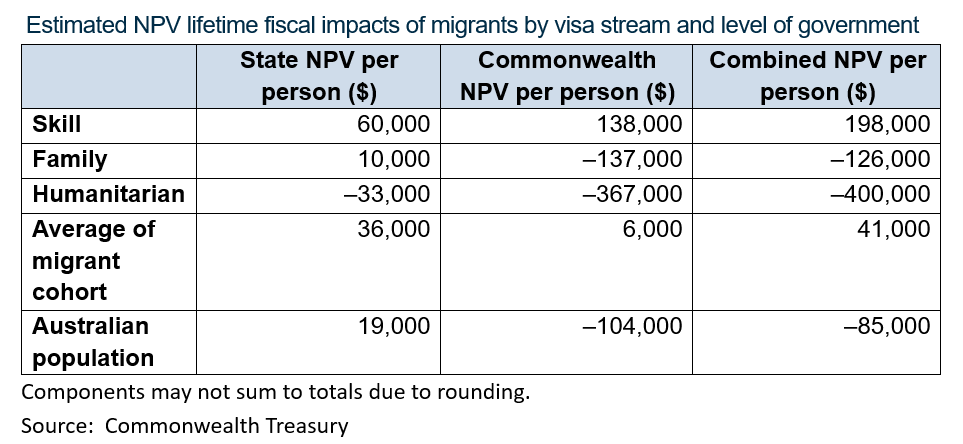
- FIONA estimates that the average Humanitarian migrant has a huge negative fiscal impact averaging $400,000 per person. More than 90 per cent of the negative fiscal impact of the Humanitarian migration stream falls on the CommonwealthGovernment, reflecting the Commonwealth's responsibility for income support payments and settlement services.
- The average estimated fiscal impact of partner visa holders (minus $92,000 for primary Partner and minus $53,000 for secondary Partner) is broadly similar to the Australian population overall (minus $85,000). Most secondary Partner applicants are children and consequently have higher revenue and expenses (especially education) costs over their remaining lifetime.
- Parent visa holdershave more negative fiscal outcomes on average (minus $394,000 for primary Parents and minus $391,000 for secondary Parents) than the population overall. This result is driven by their relatively short remaining working lives once they come to Australia, with the average age at grant being 61 years. Visa Application Charges paid by parent visa holders are small compared to the health and aged care services and transfer payments they receive from government.
- Most groups of primary skilled migrants have a large positive fiscal impact (nearly $200,000). Employer sponsored migrants are found to have the largest positive impact, while Skilled Independent, State and Territory Nominated and Distinguished Talent visa holders are also found to generate a large positive lifetime fiscal impact.
Looking at the 2018–19 permanent migrant cohort as a whole, FIONA finds that this cohort is more fiscally positive than the Australian population overall, by around $127,000 per person on average). Similarly, the average fiscal impact of migrants is $139,000 more positive than the fiscal impact of a newborn from the Australian population (minus $98,000).
The key relativities between visa streams at both the Commonwealth and State government levels are set out in the table below. The table clearly shows that skilled migration is vastly more beneficial in fiscal terms than humanitarian migration. It is also clear that the 2018–19 immigration cohort is, on average, more fiscally positive than the Australian population overall.
In addition to fiscal impacts, social considerations like crime rates are also important. Studies consistently show that first-generation immigrants have lower incarceration and offending rates than native-born citizens across most major host countries.
Only Victoria Police publish statistics by country of birth for offenders. Relating the number of alleged offenders to population size reveals that only 13 per 1000 UK-born were processed, as against 31 per 1000 Australian born. Offending rates are much higher for Aboriginal Australians.
Migrant groups born in New Zealand, Lebanon, Vietnam, Turkey and Cambodia all had a higher per capita involvement in crime than those born in Australia. Lebanese organised crime is prominent in Sydney, while Sudanese-born people are overrepresented in all categories, but particularly in the categories of aggravated robberies and burglaries. Indian and Chinese immigrants were under-represented in crime statistics. Young population cohorts contributed to higher measured offending rates for many of these groups and need to be considered.
Overall, the data are unequivocal. Skilled immigration is highly beneficial to our economy, while humanitarian admissions are costly economically. The ability of ethnic groups to fit into our society and to be law abiding is also socially very important.




 reddit this
 Del.icio.us
 Seed Newsvine
 StumbleUpon


