All this begs the question of whether what we are seeing is equal employment opportunity or the rules being bent to create an uneven playing field that is leading some key players (especially men?) to increasingly avoid public sector employment.
The business world seems to have passed peak woke, and companies are starting to escape the Diversity, Equity and Inclusion bubble. Donald Trump pulled the US government out of DEI programs and mandates, and Corporate America followed.
Another area where discrimination perhaps ought to be a key policy issue, is that of immigration. Historically, immigration policy has been reformed to (for example) abolish the former White Australia policy and to facilitate assistance to refugees and reunion of families. Few people these days would support a White Australia policy because it ruled out so many well qualified immigrants.
Advertisement
As an immigrant myself, I am a supporter of sensible immigration policies that are well thought-through and targeted at benefitting the host country. Little publicised research from no less than the Federal Treasury now, however, may be interpreted to suggest that it may be in the financial interest of Australia to be more selective and less "compassionate" in its visa policy.
The research I am referring to is the Fiscal Impact of New Australians model (FIONA), which has been developed by The Treasury to estimate the fiscal impact of permanent migrants over their remaining lifetimes in Australia. This estimate captures tax revenues and government expenses incurred by Commonwealth, State and Territory Governments that are directly attributable to migrants.
The figures on the net cost or net payment to Commonwealth revenues of different types of migrants are quite sobering:
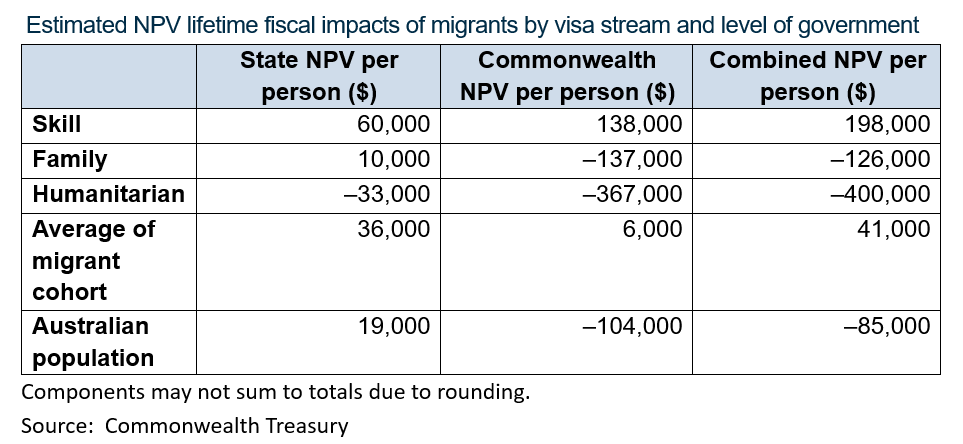
- FIONA estimates that the average Humanitarian migrant has a huge negative fiscal impact averaging $400,000 per person. More than 90 per cent of the negative fiscal impact of the Humanitarian migration stream falls on the CommonwealthGovernment, reflecting the Commonwealth's responsibility for income support payments and settlement services.
- The average estimated fiscal impact of partner visa holders (minus $92,000 for primary Partner and minus $53,000 for secondary Partner) is broadly similar to the Australian population overall (minus $85,000). Most secondary Partner applicants are children and consequently have higher revenue and expenses (especially education) costs over their remaining lifetime.
- Parent visa holdershave more negative fiscal outcomes on average (minus $394,000 for primary Parents and minus $391,000 for secondary Parents) than the population overall. This result is driven by their relatively short remaining working lives once they come to Australia, with the average age at grant being 61 years. Visa Application Charges paid by parent visa holders are small compared to the health and aged care services and transfer payments they receive from government.
- Most groups of primary skilled migrants have a large positive fiscal impact (nearly $200,000). Employer sponsored migrants are found to have the largest positive impact, while Skilled Independent, State and Territory Nominated and Distinguished Talent visa holders are also found to generate a large positive lifetime fiscal impact.
Looking at the 2018–19 permanent migrant cohort as a whole, FIONA finds that this cohort is more fiscally positive than the Australian population overall, by around $127,000 per person on average). Similarly, the average fiscal impact of migrants is $139,000 more positive than the fiscal impact of a newborn from the Australian population (minus $98,000).
The key relativities between visa streams at both the Commonwealth and State government levels are set out in the table below. The table clearly shows that skilled migration is vastly more beneficial in fiscal terms than humanitarian migration. It is also clear that the 2018–19 immigration cohort is, on average, more fiscally positive than the Australian population overall.
Advertisement
In addition to fiscal impacts, social considerations like crime rates are also important. Studies consistently show that first-generation immigrants have lower incarceration and offending rates than native-born citizens across most major host countries.
Only Victoria Police publish statistics by country of birth for offenders. Relating the number of alleged offenders to population size reveals that only 13 per 1000 UK-born were processed, as against 31 per 1000 Australian born. Offending rates are much higher for Aboriginal Australians.
Migrant groups born in New Zealand, Lebanon, Vietnam, Turkey and Cambodia all had a higher per capita involvement in crime than those born in Australia. Lebanese organised crime is prominent in Sydney, while Sudanese-born people are overrepresented in all categories, but particularly in the categories of aggravated robberies and burglaries. Indian and Chinese immigrants were under-represented in crime statistics. Young population cohorts contributed to higher measured offending rates for many of these groups and need to be considered.
Overall, the data are unequivocal. Skilled immigration is highly beneficial to our economy, while humanitarian admissions are costly economically. The ability of ethnic groups to fit into our society and to be law abiding is also socially very important.
Discuss in our Forums
See what other readers are saying about this article!
Click here to read & post comments.
2 posts so far.




 reddit this
 Del.icio.us
 Seed Newsvine
 StumbleUpon


