Turning on news media in today's world is an experience met with confused political and economic disarray. All political parties engage in criticism of their opponents. The acrimony has increased in the political debate to where it is disengaging the public. The public interest switching off is characterized in the growing support for a political party that has for years been considered a minor political player. This raises the question of credibility not only of politicians of all persuasions; but also, of supposed media experts and commentators. This short discussion attempts to draw some sensible answers to what underlies today's political acrimony in the hope that some semblance of sensibility emerges in this important national debate.
The structure of the discussion will be to identify and comment upon the structural reform of the Australian economy that followed the collapse of the post-World War II Bretton woods international monetary system.
Economic systems and political background
Advertisement
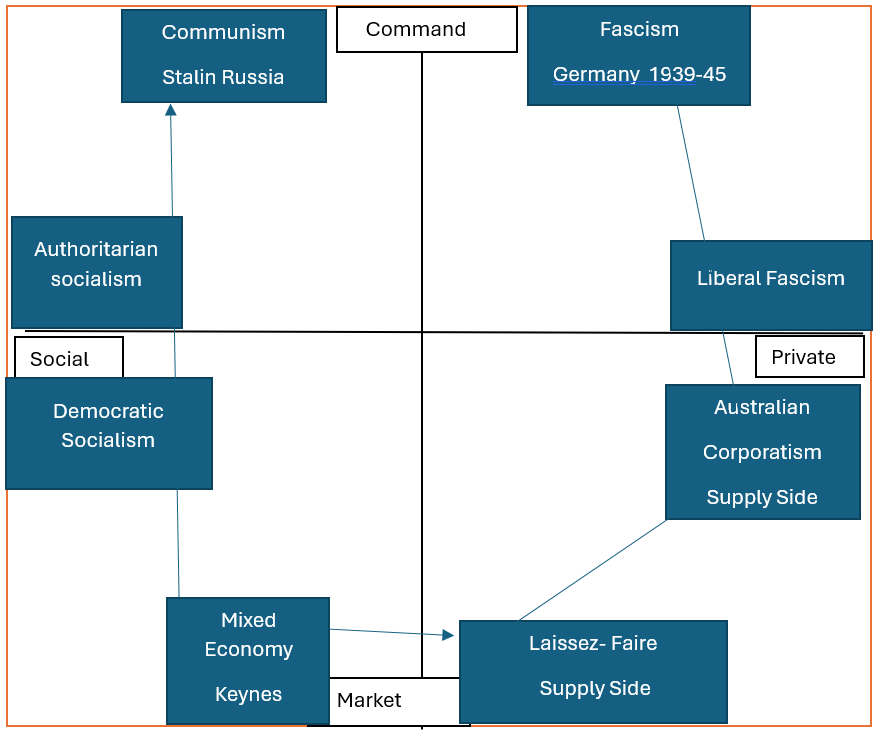
The horizontal axis describes the economic order or ownership of the means of production distribution and exchange; the vertical axis describes the political order or decision-making process
The diagram of economic systems is first year economics. It allows the identification of prevailing economics systems and any change over time to an economic system. It should be noted that an economic system left of a mixed economy cannot be structured under the Australian Constitution. Section 92 of the Australian Constitution prevents the establishment of a socialist economic system. For example, in 1947, Prime Minister Ben Chifley's attempt to nationalize the banking sector was disallowed under a High Court challenge. Structural change to the Australian economy under the Australian Constitution must move rightwards from the mixed economy to embrace authoritarian capitalism. Ultimate authoritarian capitalism could finish as fascism similar to Germany and Italy in the 1930's. Interpretation of the diagram is important to understand what is happening to the Australian economy.
The Australian Constitution sets out the powers and responsibilities of the Commonwealth Government and provides for industry protectionism. Industry protectionism began as early as the 1860's following the British Government granting independence to Colonial Governments. Over the last three decades of the nineteenth century, groups emerged supporting either free trade or protectionism. These groups dominated Colonial Parliaments[i]. Indeed, the first elected Federal Government in 1901 was won by protectionists supported by the Labor Party[ii]. Free traders formed the opposition. Similarly, in the 1903 Federal election, Protectionists supported by Labor won Government over the free traders and one independent. Economic philosophy at the time of Federation remained the prevailing philosophies of that era namely Austrian economics, Classical and Neoclassical Philosophies, and Quantity Theory of Money (monetarism).
None of those prevailing philosophies had answers to the Great Depression and the 1930's. In 1936, John Maynard Keynes published his famous "General Theory of Employment, Interest and Money". Keynes himself had been brought up under classical and neoclassical economics; and had taught those philosophies at university level. The failure of them in a time of crisis turned his mind to write his famous book which rejected the philosophies of yesteryear.
The Second World War erupted before his new thinking could be introduced. However, in 1944, at Bretton woods the US Treasury officials, Harry Dexter White and Henry Morgenthau, combined with John Maynard Keynes to structure a post-World War II financial system. The system of fixed exchange rates that emerged was underwritten by the US Treasury guarantee of gold being valued at $35US an Ounce. Post World War II, the western international economic system was underwritten by Keynesian demand management economics. In terms of economic philosophy, protectionism triumphed over free traders
No economist from the failed free market philosophies of the pre–Great Depression era was given a voice in structuring the post World- War II financial system. However, in 1947, Frederich Hayek of the Austrian school called a meeting at Mont Pelerin in Switzerland which reignited the failed economics from yesteryear. From that meeting emerged support for the economics of yesteryear which embraced the modernized versions of Frederich Hayek and Professor Milton Friedman. The Chicago School of Economics lurked in the background. Interest in economics of yesteryear, or supply side economics as it became known emerged as Thatcherism (Great Britain), and Reaganomics (USA). The difference between Thatcherism and Reaganomics was simply the budget outcome. Thatcherism embraced balanced budgets whilst Reaganomics accepted budget deficits for defense spending.
Advertisement
As the Bretton Woods fixed exchange rate monetary system was underwritten by the US Treasury guarantee of gold valued at $35 US and ounce, it eventually failed in 1971 as the growth of $US notes over time threatened the credibility of the system. Consequently, President Nixon withdrew US support for the system. From then on, the international monetary system that emerged has been one of flexible exchange rates determined by international demand for currencies. Reaganomics supply side economics was adopted in the USA whilst Thatcherism supply side economics was adopted in Australia by the Hawke Administration elected in 1983. Free market globalization became the dominant economic philosophy in modern western economies.
Supply side comes to Australia
On election to office in 1983, the Hawke Administration began to restructure the remnants of the Keynesian economic system as a free market economy. One of his first moves was to introduce the Accord to restructure the labour market. He then proceeded to deregulate the financial system by beginning to privatize the Commonwealth Bank which was sold in three tranches between 1991 and 1996. In the March 1991 Hawke- Keating Financial Statement, supply side economics was given status when the objective was announced to reduce general tariffs to 5% by 1996. These moves effectively restructured the post-World War II demand management Australian economic system and established the supply side economic model of Margaret Thatcher. The economic system that emerged is identifiable in the diagram above as corporatism.
Corporatism is defined in the Penguin Macquarie Dictionary of Australian Politics, page 96, as follows:
Discuss in our Forums
See what other readers are saying about this article!
Click here to read & post comments.
2 posts so far.




 reddit this
 Del.icio.us
 Seed Newsvine
 StumbleUpon