Introduction
The media debate over tariffs and productivity is not based upon sound economic theory. The current debate in western economies should be about generational change and rejection of post 1971 globalised market economics. Moreover, the advent of AI and its potential impact upon the structure of the economy and service sector employment appears unable to generate comment from either major political party or plethora of economic "experts" and commentators gracing our nightly television screens. This short essay attempts to raise some discussion of the potential impact of AI on the economic system and employment.
The economic model that eventually emerged post 1971 was a monetarist/neoclassical synthesis based upon the heroic assumption of rational expectations. Across western economies, monetarist central banks assumed management of monetary policy. As governments abandoned the post War economics of J M Keynes, direct management of the economy was abandoned in favour of market theories. This mix of philosophies from the late nineteenth early twentieth century has no answers to what is happening in today's real world let alone offering a sound strategy for what is quietly infiltrating our economic system in the guise of economic efficiency.
In the field of international economics, an economy is considered efficient when both internal and external sectors are in balance. Internal balance is achieved when an economy is operating at full employment output under stable prices. External balance is achieved when there are no unwanted movements in the balance of payments. Critical in external balance is balance on current account. The balance on current account is the net position of the current account combining the balance of trade and the net income deficit. The net income deficit is the difference between the income flow from foreign investment and the net income flow of income earned by Australian investment earned overseas. Hopefully this becomes clearer as the discussion progressesInternal balance
Advertisement
Chat 1
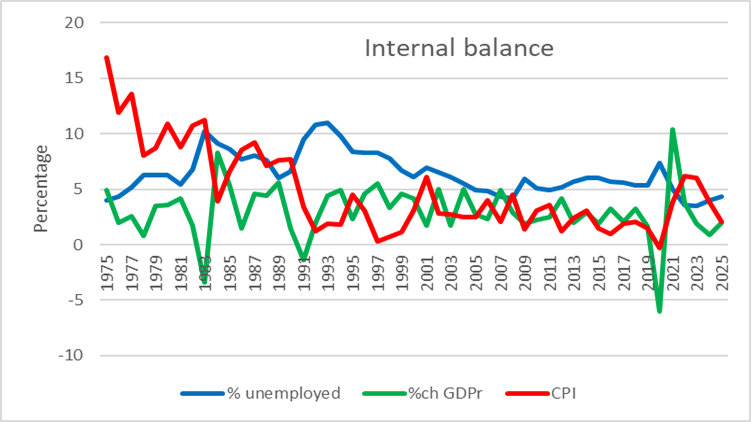
Compiled from RBA Statistical tables Feb. 2026
"Internal balance is achieved when an economy is operating at full employment output under stable prices".
Full employment in Australia is considered the RBA's NAIRU otherwise known as the natural rate of unemployment. NAIRU, which stands for the Natural Accelerating Inflation Rate of Unemployment, is considered to be between 4% - 4.5% unemployment. When actual unemployment is at NAIRU, the RBA considers inflationary pressures are neutralised. Consequently, NAIRU becomes the determinant of domestic monetary policy and interest rate settings.
NAIRU is directly derived from the rational expectations Phillips Curve. The monetarist/ neoclassical synthesis that underwrites modern macroeconomics across the western world is based upon rational expectations. It first emerged in Britain in 1976 under British Labour. The concept came to Australia in 1993 when the RBA assumed independent setting of monetary policy.
Advertisement
Facing the increasing adoption of AI, the contemporary real issue becomes what happens to monetary policy settings. What level of unemployment becomes the new natural rate of unemployment or NAIRU. There is no serious discussion on the impact of AI on Australian employment. However, daily there is news of a major service industry shedding large numbers of employees. Given the nature of service industry employment, it is reasonable to expect unemployment will not be confined to low skilled workers. Many highly skilled industries such as law, accounting, banking, public service, and other advisory industries must be natural targets for AI.
Upon acceptance of AI, the big questions for government becomes economic policy.
What happens to NAIRU and monetary policy?
Discuss in our Forums
See what other readers are saying about this article!
Click here to read & post comments.
2 posts so far.




 reddit this
 Del.icio.us
 Seed Newsvine
 StumbleUpon