Europe's waterways exemplify this principle perfectly.
The Rhine-Danube corridor is already recognised by the European Union as the principal west-east transport axis across continental Europe and contains the longest inland-waterway component of the TEN-T corridors. It connects the North Sea and western European industrial centres through Germany and Austria to Vienna, Bratislava, Budapest, Belgrade, Bucharest and ultimately the Black Sea. It also connects with maritime ports, railways, roads and logistics terminals.
But a river does not respect administrative borders. Its water does not stop at a national frontier, and neither should its governance.
Advertisement
A functioning European blue-waterway system therefore requires far more than dredging individual stretches of river. It requires common standards, coordinated investment, interoperable navigation systems, resilient ports, multimodal terminals, real-time hydrological information and contingency arrangements linking waterways with rail and road. It also requires a new understanding of resilience.
The old model sought to make waterways predictable through engineering. The new challenge is to make the connectivity system adaptable when nature becomes unpredictable.
Low water is only one side of the problem. Flooding can be equally disruptive. Climate change means that Europe's waterways must increasingly be designed and governed for extremes rather than averages. The European Commission itself has recognised that droughts and floods can temporarily block waterways, reduce vessel loads and force cargo onto other transport modes, while climate change is expected to make such disruptions more frequent.
This makes resilience a connectivity issue.
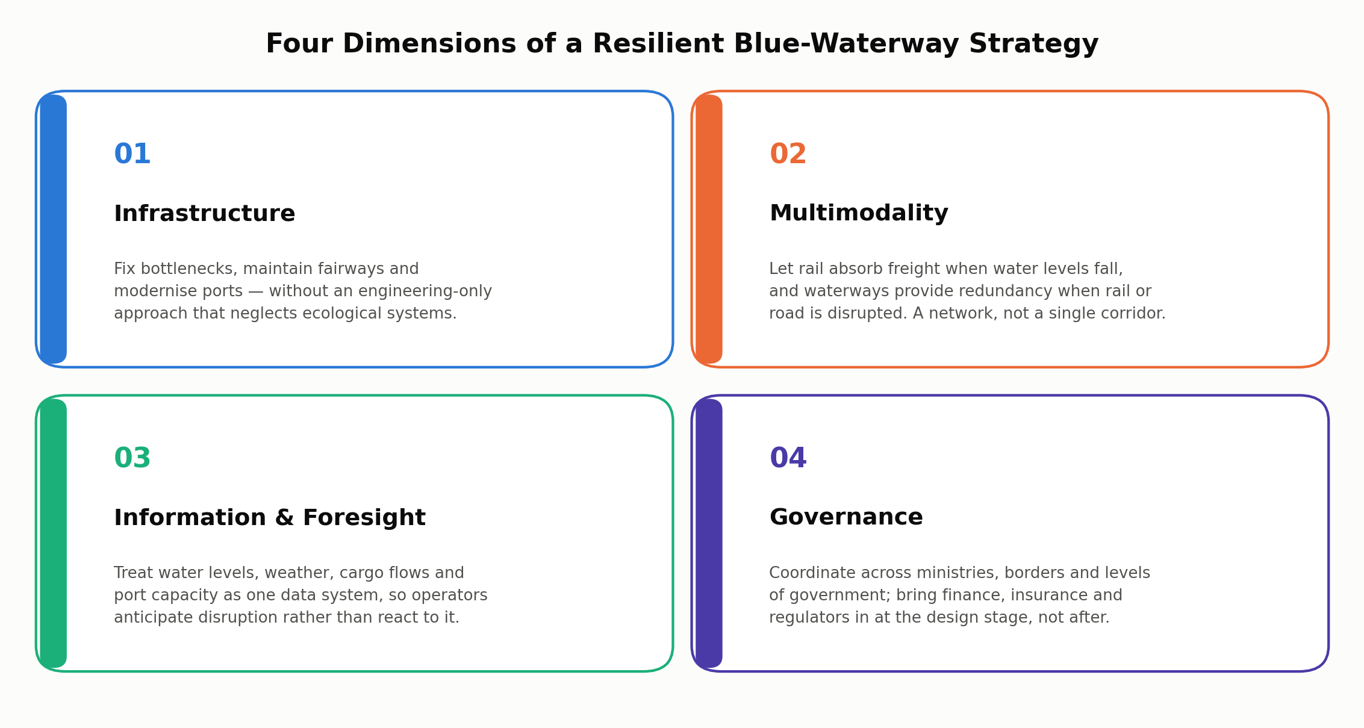
A resilient blue-waterway strategy would therefore have at least four dimensions.
Advertisement
Figure 1. Four dimensions of a resilient blue-waterway strategy, per the GAFG Connectivity Doctrine’s principle that coherence—not capacity—is the measure of a corridor’s strength.
First, infrastructure.Europe must address persistent bottlenecks, improve fairway maintenance and modernise ports and terminals while avoiding an exclusively engineering-driven approach that neglects ecological systems.
Second, multimodality.No river should be expected to carry the entire burden alone. When water levels fall, rail should be able to absorb additional freight; when rail or road corridors are disrupted, waterways should provide redundancy. Connectivity means having alternatives. This is, in essence, the difference between a corridor and a network: a corridor concentrates risk at one point and breaks when that point fails, while a network spreads risk across many links and reroutes around failure. Europe’s blue-waterway system should be designed and governed as the latter.
Discuss in our Forums
See what other readers are saying about this article!
Click here to read & post comments.
1 post so far.




 reddit this
 Del.icio.us
 Seed Newsvine
 StumbleUpon