On Line Opinion is a not-for-profit publication and relies on the
generosity of its sponsors, editors and contributors. If you would
like to help, contact us.
___________
The financial cost to the state isn't huge, but it speaks volumes about this overlooked corner of injustice. Far more significant is the damage these cases do to the public's faith in a fair justice system. And the toll on the men who live through them - and their families - as the steady stream of letters I receive makes clear.
Given how rarely these cases get any public attention, it is worth sharing a small selection, both in this blog and in my new podcast, which features some of these men describing their ordeals. Please help me circulate the podcast, available on YouTube and soon on Spotify.
Advertisement
I've told you about Simon.
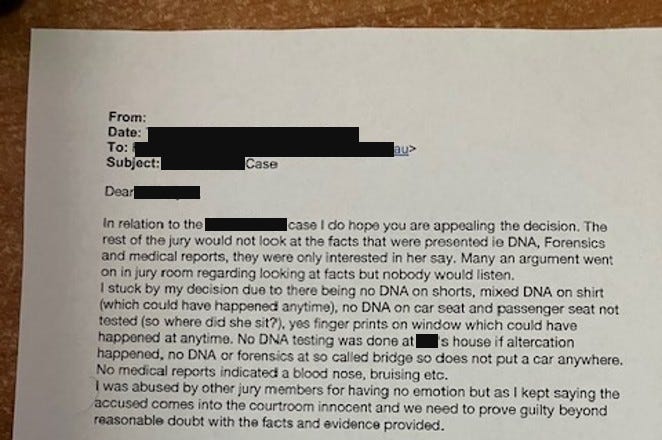
Now comes Alan's story. (His name and some key details are disguised for legal reasons.) Alan spent three years in prison, following a sexual assault allegation from a 14-year-old girl who was a foster child living with his partner. Soon after he was convicted, his lawyer received a letter from a member of the jury that had convicted him, pleading that he appeal the decision. Here it is:
It has to be said: every sexual assault allegation deserves to be taken seriously, and when the alleged victim is a child, a jury will inevitably feel the weight of that. But feeling that weight is exactly why the presumption of innocence exists - as a safeguard against verdicts driven by how a case feels, rather than by what the evidence actually shows.
That's what makes this juror's letter so striking. It's a raw, frustrated account of a lone voice trying to hold the rest of the jury to that standard - and being abused for it. The rest of the jury, the juror wrote, "would not look at the facts that were presented i.e. DNA, Forensics and medical reports, they were only interested in her say... nobody would listen." The juror held out: "I was abused by other jury members for having no emotion but as I kept saying the accused comes into the courtroom innocent and we need to prove guilty beyond reasonable doubt with the facts and evidence provided."
The evidence given in Alan's case, as laid out in the appeal documents, was extraordinary. Asked directly whether Alan had touched her, one exchange ran:
Advertisement
Q. Did (the accused) touch your vagina through your pants, true or not true?
A. True, true, not true who knows. Who fucking knows.
The complainant, who had a documented history of mental health issues, gave evidence a court-appointed expert described as riddled with "outbursts, swearing, refusing to continue with her evidence." She had "a tendency to behave in a certain way when she had not taken her medication, to run away from caregivers and be violent towards them, to make false allegations against caregivers and to self-harm." That history never reached the jury.
Even the trial judge struggled to watch it unfold, telling the court mid-trial: "I'm deeply troubled that this young person clearly does not want to be there... how, unless things improve, the Crown can rely on this material to sustain verdicts of beyond reasonable doubt, is very difficult for me to see." The Crown Prosecutor himself all but agreed: "I'm not sure if the complainant's evidence does get much better. She does become much more frustrated."






 reddit this
 Del.icio.us
 Seed Newsvine
 StumbleUpon


