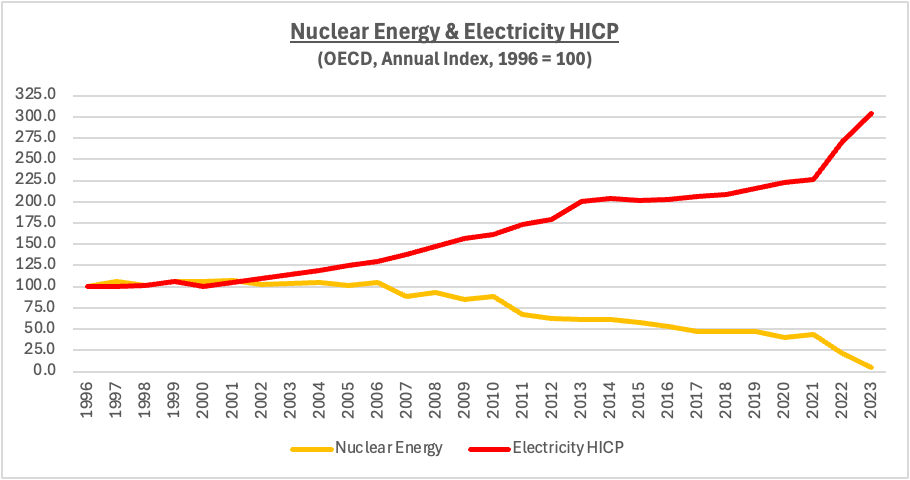
The third chart demonstrates how prices are driven by marginal costs not total costs. Relatively cheaper nuclear, compared to renewables, declines every year from 2006 to 2023, 104.5 to 4.5, thus inflating electricity Harmonized Index of Consumer Prices (HICP) from 129 to 303.
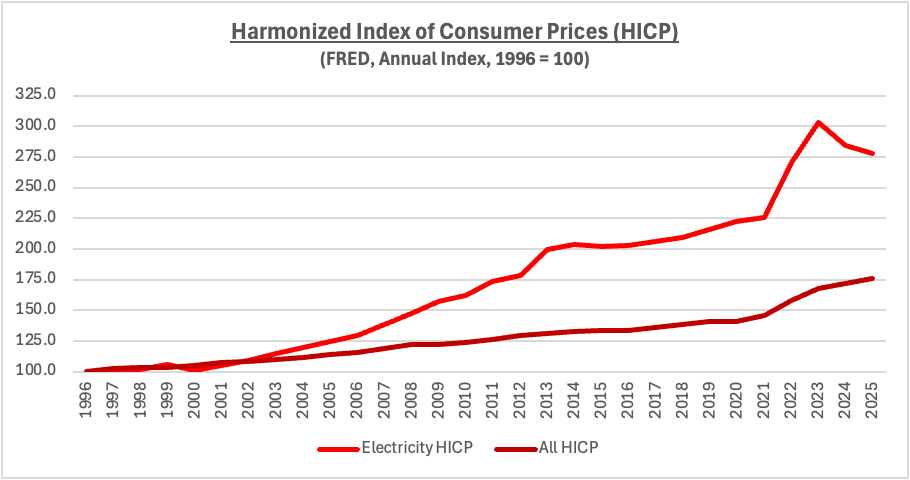
The fourth chart illustrates electricity pulling up all HICP in the 21st century. The former goes from 100 in 2000 to 303 in 2023, with the latter going from 105 to 167. Electricity, as an input into everything, fuels cost-push inflation, just as currency inflates demand-pull.
Advertisement
Economics
Mainstream static economics teaches that taxpayer subsidies, such as to German renewables, will increase supply and lower prices. It also teaches that rising input costs, say in such renewables, will decrease supply and escalate prices. Dynamic incentives are the missing link.
Free market economics, like in Murray Rothbard's Power and Market, argue that subsidies will cause both effects, of increasing supply and rising input costs. But the latter effect will tend to overpower the former. Thus, prices will tend to be high and rising as time goes by.
The reasons for this are: 1.) inefficient businesses are the ones who are incentivized to seek subsidies or rent seek; 2.) these subsidies incentivize such businesses to stay inefficient or worsen; 3.) more resources are diverted into #1, leading to more #2. Rinse and repeat.
Coda
President Trump issued four executive orders in 2025, aimed at jump-starting American nuclear energy. In summary, these "focus primarily on rapid deployment of advanced nuclear reactors while also providing support and further study for other parts of the fuel cycle."
Robert Bradley, in Nuclear Power: A Free Market Approach, notes: "The past is a sunk cost. Currently operating nuclear plants can be presumed to be economical. Regarding new capacity, [they] have not demonstrated their economic viability versus other forms of thermal generation."
Advertisement
Germany should have properly applied the precautionary principle and not shut down nuclear. And, although free markets are better than government fiat, some second-best policy choices are better than others. Thus, new or old nuclear should be built or rebuilt, for as Julian Simon once wrote:
"Nuclear power is fundamental to a discussion of energy because it establishes the long-run ceiling to energy costs. No matter how much any other source of energy costs us, we can turn to nuclear power at any time to supply virtually all our energy needs for a very long time."
"The opposition to it is mainly ideological and political. … The aim of [which] is not increasing the availability of energy and consumer benefits, but decreasing the use of energy for supposed environmental gains and beliefs about the morality of simple living."
Discuss in our Forums
See what other readers are saying about this article!
Click here to read & post comments.




 reddit this
 Del.icio.us
 Seed Newsvine
 StumbleUpon


