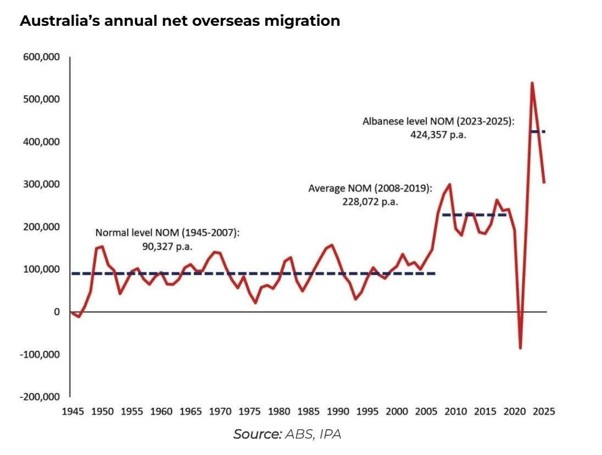
Annual intake more than doubled from 2005 and 1.3m have arrived in the last 3 years - a 5% population increase from immigration alone.
Australia has an institutional accountability problem, and the growing dysfunction of the immigration system is one of its clearest symptoms.
Advertisement
Through much of the 1980s and 1990s, Australia's annual net overseas migration generally sat between roughly 50,000 and 120,000 people per year, with population growth more evenly split between migration and natural increase. Since the mid-2000s, however, Australia has gradually normalised a permanently high-migration growth model, with annual intake frequently exceeding 200,000 people and peaking above 500,000 post-COVID. The country of origin has significantly shifted from Europe and the Anglosphere to Asia and the Middle East.
At the same time, Australia's overseas-born population has roughly doubled since 2000, rising from around 4.3 million people (roughly 23% of the population) to almost 9 million today (around 32%).
The issue is not simply the scale itself. Australia has historically integrated immigrants remarkably well. The issue is that housing, infrastructure, enforcement capability, and civic integration systems were never redesigned for a country operating permanently at these intake levels.
Social cohesion is not automatic. It depends on functioning institutions, broadly shared economic opportunity, enforceable rules, and a general belief that the system is fair.
Those conditions are weakening.
The debate is often framed (particularly by those with a vested interest in the status quo) as though Australians must choose between being 'pro-immigration' or 'antiimmigration' or more starkly, 'inclusive' or 'racist'. This is a deflection from the more important question which is whether the system remains fit for purpose.
Advertisement
For vested interests, it certainly has been. For Australian's in general, it is not, and increasingly so.
The immigration system now serves too many competing interests unrelated to the long-term interests of the country itself:
- universities dependent on international student revenue,
- corporations seeking cheaper and more flexible labour,
- property markets dependent on population growth,
- governments dependent on headline GDP growth,
- Immigrant groups themselves, who have foreign and domestic policy objectives not necessarily aligned with Australian interests
- and bureaucratic systems that expand alongside higher demand for government services
Discuss in our Forums
See what other readers are saying about this article!
Click here to read & post comments.
2 posts so far.




 reddit this
 Del.icio.us
 Seed Newsvine
 StumbleUpon