
"The fool doth think he is wise, but the wise man knows himself to be a fool." So said the character Touchstone, the court jester, in Shakespeare's comedic play As You Like It.
If England's greatest poet and dramatist were still alive, he would point out the strange situation we find ourselves in today, namely that the people who know the least about many topics are often the most vocal in supporting their causes. For example, in the climate change debate, activists claim with self-righteous certainty that we are causing a climate emergency due to our emissions of carbon dioxide, and that vast changes in our society are needed to avert catastrophe. Yet experts aren't nearly as confident. Although the media and world leaders tell us that the science is settled, a deeper dive into the issue reveals that it isn't as clear cut as they make it out to be.
Advertisement
This is an example of the Dunning-Kruger effect. The Dunning-Kruger effect is a cognitive bias that makes us more likely to overestimate our abilities when our skills or knowledge aren't adequate and to underestimate our abilities when we have greater developed skills or knowledge. A cognitive bias is an error in our thinking that affects how we perceive others, ourselves, or the world and influences how we make decisions. This can lead to irrational judgements and beliefs of certainty despite lack of credible evidence. In addition to the Dunning-Kruger effect, some other cognitive biases are the confirmation bias (interpreting new information as confirmation of your pre-existing beliefs), self-serving bias (the tendency to take personal responsibility for positive outcomes and blame external factors for negative outcomes), and availability bias (thinking that things that readily come to mind are more common than is actually the case).
In the seminal paper by Kruger and Dunning (1999), "Unskilled and unaware of it: How difficulties in recognizing one's own incompetence lead to inflated self-assessments," they found that we often overestimate our abilities despite lack of knowledge in a certain subject. Although the applicability of the Dunning-Kruger effect is debated, it can explain many situations where people are overconfident in their assessments despite lack of knowledge, as well as the more modest outlook of subject matter experts. A striking example of the latter can be seen with Socrates' famous statement in Plato's Apology, "I neither know nor think I know." Socrates was seen as one of the wisest men, and this humility is often characteristic of philosophers and scientists who, while being truly knowledgeable, recognize the limitations of their knowledge when there is much more that can be known.
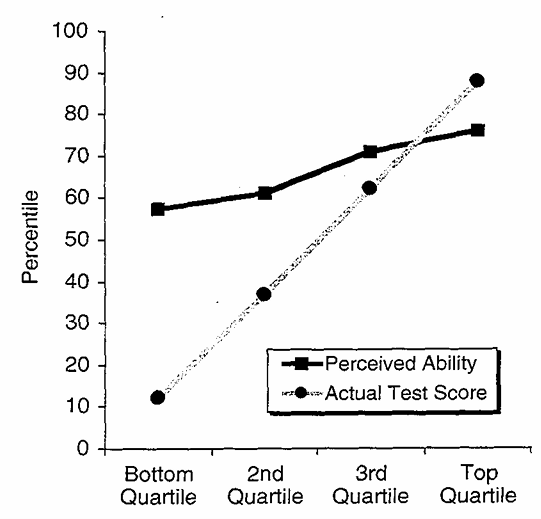
In Dunning and Kruger's study, they had people perform a test and then guess their score as a percentile relative to others. Participants were separated into quartiles based on their estimated scores: those who performed in the bottom 25%, those who scored in the top 25%, and those who scored in the two middle quartiles. For each quartile, the average performance score and the average estimated score was plotted, an example of which can be seen in the graph below.
Source: https://bruceabernethy.com/assets/mirror/1999-kruger.pdf
Advertisement
We can see a significant overestimate of 46 percentile points for participants in the lowest quartile, illustrating that the effect is most significant for those without as much knowledge. Participants in the top quartile, while underestimating their result, only did so by less than 20 percentile points.
In the climate change debate, we see this played out point by point. Activists are the loudest and most dramatic in their demands and confidence that we are entering a human-caused climate crisis. Scientists, on the other hand, are much more wary of making such zealous claims, even those who support the scare in general.
At COP30 in Belem, Brazil last month, dozens of indigenous protestors with batons forced their way into the conference to call for more action on climate change and protest the environmental damage caused by developments. They caused injuries to security guards, and throughout the week, others joined the protestors outside the conference to demand for further action. This clearly illustrates the confidence these protestors had in their mission and "crusade" to stop climate change, despite the fact that it is extremely unlikely that any of them are climate scientists or have in-depth knowledge of the field.
On the other hand, most climate scientists are dubious about such claims. In Kesten C. Green and J. Scott Armstrong's report "Global Warming: Forecasts by Scientists versus Scientific Forecasts," they write that "Climate is complex and there is much uncertainty about causal relationships and data" and that "we are not convinced that current knowledge about climate is sufficient to make useful long-term forecasts about climate." After analysing the works of many scientists, they write that there is not enough evidence to warrant vast policy changes, and that they were "unable to identify any scientific forecasts of global warming." This is because even experts failed to use well-established forecasting principles that would be required if indeed their forecasts were to be considered "scientific forecasts." I explained this to my class at Carleton University (see here) in Ottawa when I was a sessional lecturer in the Department of Earth Sciences.
Interestingly, Professor Emeritus and applied mathematician Dr. Chris Essex of the University of Western Ontario, a true expert in the mathematical models that underlie climate change concerns, said that "Climate is one of the most challenging open problems in modern science. Some knowledgeable scientists believe that the climate problem can never be solved."
In Veritasium's recent video, "What A Simple Question Reveals About The Most Dangerous Cognitive Bias," host Dr. Derek Muller, an Australian-Canadian physicist, educator, and science communicator, explains, "In a complex world with unclear noisy feedback where our brains are overwhelmed, a set of simplistic biases can take over." The climate change debate is indeed extremely complex, and to try to understand it, the average person must make mental simplifications and select certain evidence to support their beliefs. This is because, from climate forecasting to the historical record, from carbon dioxide's effect on warming to policy making and renewable energy, there is an overwhelming amount of information, much of it very complicated, that the layperson simply does not know about. So, when the press and politicians give us a simple explanation, for instance, that there is an impending climate catastrophe and all we have to do to stop it is reduce greenhouse gas emissions, uninformed activists are quick to take that idea and run with it.
Dr. Don Moore, professor of Management of Organizations at UC Berkeley Hass, explained in the Veritasium video that, "It is easy for me to make the case that overconfidence is the most dangerous of the human biases. Overconfidence gets us into all sorts of trouble. It leads us to take risks, make commitments, enter contests, try things that will ultimately fail, sometimes in costly, embarrassing, and dangerous ways."
So, how can we overcome this? The simple answer is more knowledge and a willingness to learn. In their study, Dunning and Kruger concluded that "improving the skills of the participants…helped them recognize the limitations of their abilities." The more we learn about climate change science, the more we will come to realize how vastly complex the field is and how insignificant humanity's carbon dioxide emissions actually are. This is borne out in the historical record as well as the saturation effect of carbon dioxide, in which adding more of the gas to the atmosphere makes a smaller and smaller impact as the concentration increases.
Moore continued, "We should listen to people who disagree with us" and that we must "understand the best arguments of your critics." Rather than immediately finding fault with anyone who disagrees with you, this open-mindedness is crucial for a more rounded understanding of any topic.
This is more than just an academic point when it comes to climate change. After all, to supposedly "stop climate change," governments want us to spend trillions of dollars, turn off our most reliable energy sources, and overhaul our economies for little or no other benefit, bankrupting us in the process. We must expose this pervasive cognitive bias to lead to more impartial discussions and hopefully turn the public's attention to what the actual experts are saying rather than the simplified, politically correct narrative espoused by activists and their allies in the press and government
And what are many of the scientists saying? In just a few days, I was able to secure the endorsement of 143 of them of ICSC's Climate Scientists' Register which said:
We, the undersigned, having assessed the relevant scientific evidence, do not find convincing support for the hypothesis that human emissions of carbon dioxide are causing, or will in the foreseeable future cause, dangerous global warming.
Such a message doesn't sell newspapers, inspire social justice warriors to take to the streets, or give bureaucrats and politicians a cause célèbre to boost their careers. But it is a statement from real experts that we should take much more seriously.




 reddit this
 Del.icio.us
 Seed Newsvine
 StumbleUpon


