On Line Opinion is the only Australian site where you get all sides of the story. We don't charge, but we need your support. Here�s how you can help.
On Line Opinion is a not-for-profit publication and relies on the
generosity of its sponsors, editors and contributors. If you would
like to help, contact us.
___________
I hadn't planned to March for Australia, but my Canberra visit to lobby parliamentarians in late August coincided with the August 31 march. Having watched what was happening in the UK with huge numbers taking to the streets to protest mass immigration, I was curious to see how it would pan out here. It was interesting to see how many ordinary Australians would show up after our predictable mainstream media ran around like chickens with their heads off, claiming it would be overrun by Nazi bullies.
Well, there were none of them that day in sunny Canberra as many thousands of people strode peacefully over Commonwealth Bridge and up to Parliament House. All sorts, including plenty of families with kids, women of all ages. But strikingly, huge numbers of men. Ordinary blokes, many who'd travelled from rural areas outside Australia.
The chatty, friendly crowd shared similar stories. People forced to move out of the big cities because they can no longer afford housing. Older people whose adult kids simply can't find anywhere to rent. Frustrations with strains on infrastructure, health services, lengthening commute times, and concerns about community harmony.
Advertisement
But talking to many of the blokes it struck me that many of these problems are impacting most on the ordinary Aussie blokes who are already at the bottom of the pile. They have long been missing out on the perks and privileges being dished out to those rating higher on the DEI intersectionality ladder. It seems logical that it is men who are most likely to be kicked to the curb by the pressures being caused by the current high levels of immigration.
Mass immigration is a men's issue, US Secretary of State Marco Rubio pointed out in his 2024 essay, How Mass Migration Undermined Men, which traced the erosion of men's economic footing to a combination of deindustrialization, offshoring, and open borders policies, all exacerbating issues like job displacement, wage stagnation and barriers to family formation.
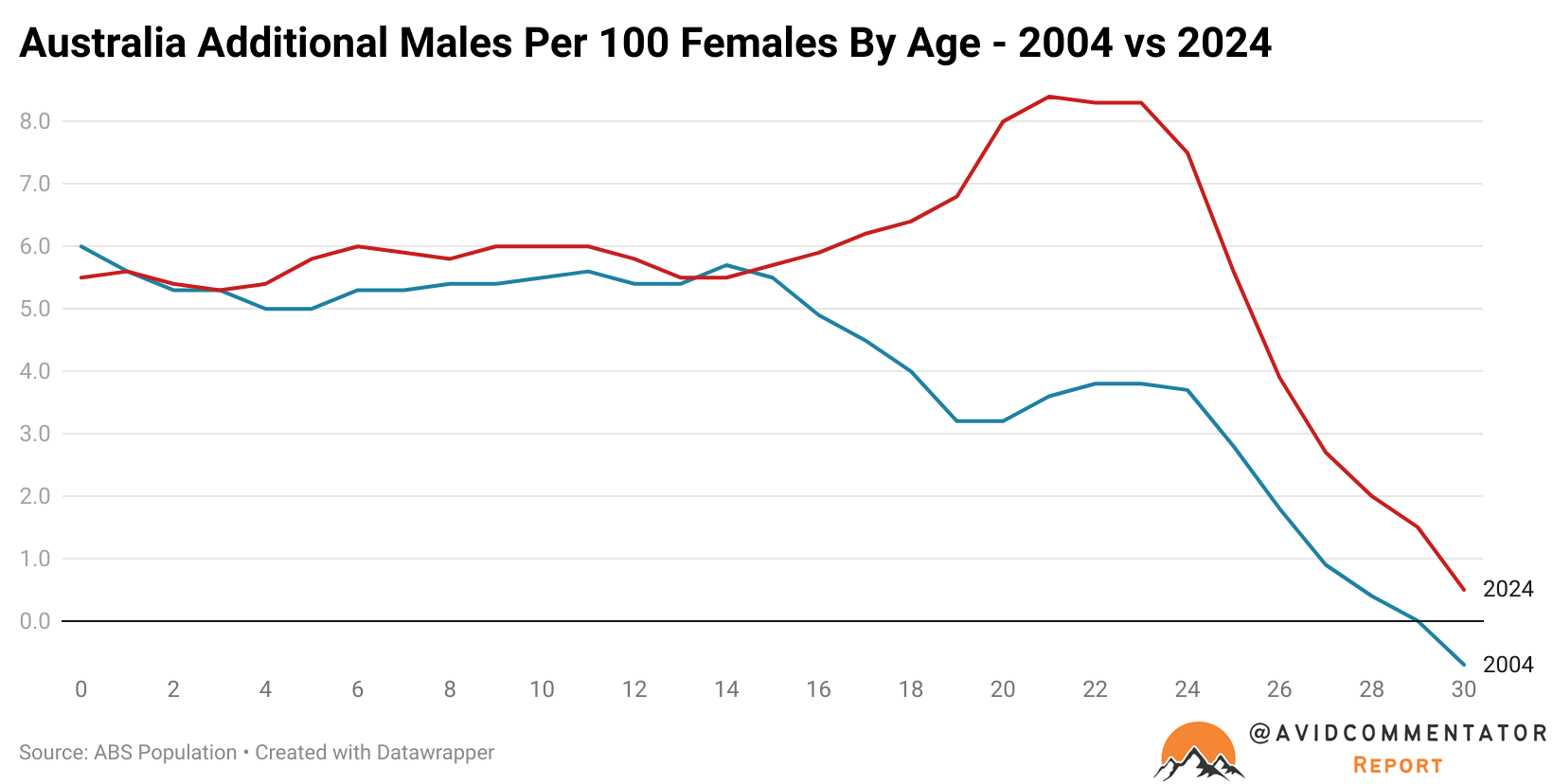
Obviously, the Australian situation is different but take a look at this interesting graph showing a huge bulge in the number of young men suddenly swelling our population, providing additional competition for jobs, housing, education, and for women.
The graph is the work of journalist and analyst for News.com.au, Tarric Brooker, who says migration has to be the driving force for this change.
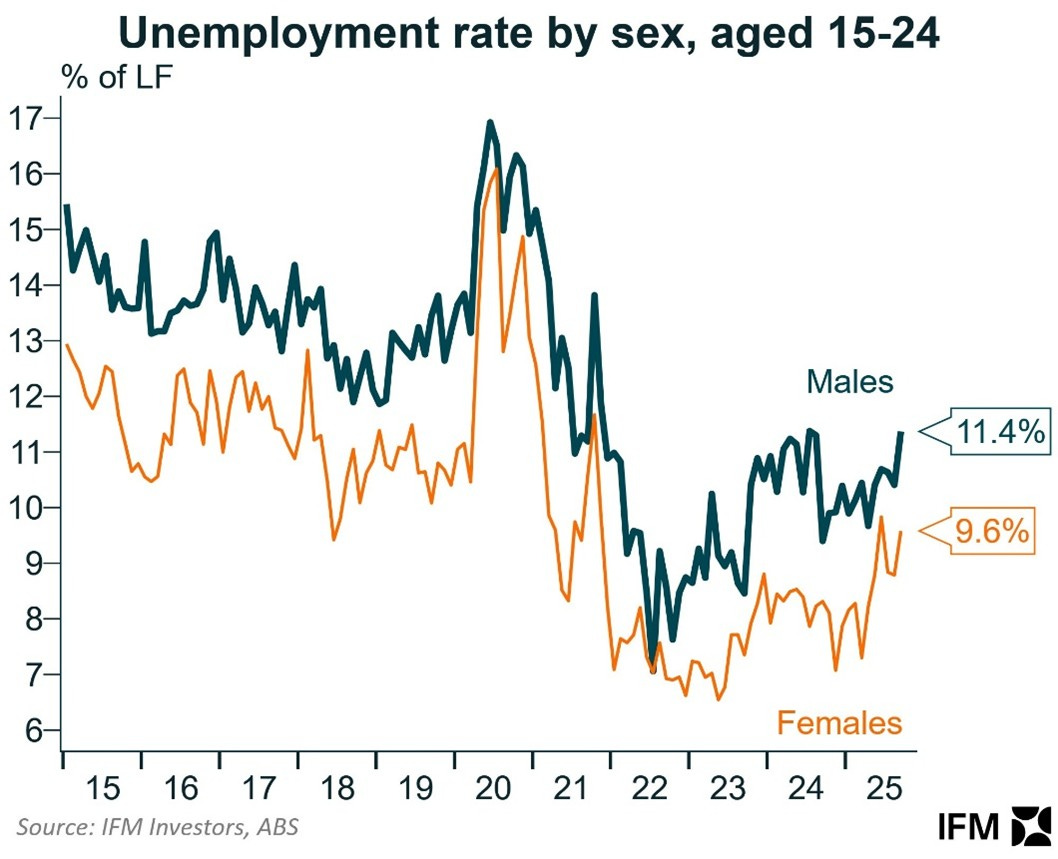
It's no wonder young men are having a particularly hard time finding jobs. Look at this graph posted online this week by Alex Joiner, chief economist at IFM Investors.
Advertisement
Many young people are struggling but, unsurprisingly, it is young men who are really up against it. (Male employment prospects aren't helped by the fact that so many boys are failing or dropping out from school, as I explained in my recent blog on the boys' education crisis. University attendance figures published earlier this month showed two of every three students starting university are now female – a fact that Education Minister Jason Clare was keen to bury, as Janet Albrechtsen pointed out in The Australian.)
Many will have seen the video of Morgan Cox, a young father on the brink of homelessness who fronted the ABC's Q&A panel in May this year and asked politicians about their plans to cut immigration and make housing more affordable for struggling Aussies.
"I recently got a rent increase notice for an additional $180 a week, which works out to be about $10,000 a year," Morgan began.
"I tried to find a cheaper place and there just aren't any. What little is available, there's dozens of people lined up."
"Lots of them are immigrants and they have plenty more money than I can possibly get."
The hard working dad revealed that his young family had already been forced out of Sydney by rapidly rising rent costs - partially driven by an influx of people moving to the city increasing the demand for property.
"'I'm already working two jobs," Mr Cox said.
"One more rent increase and my family - my one-year-old baby - we're facing homelessness and we've got nowhere to go".
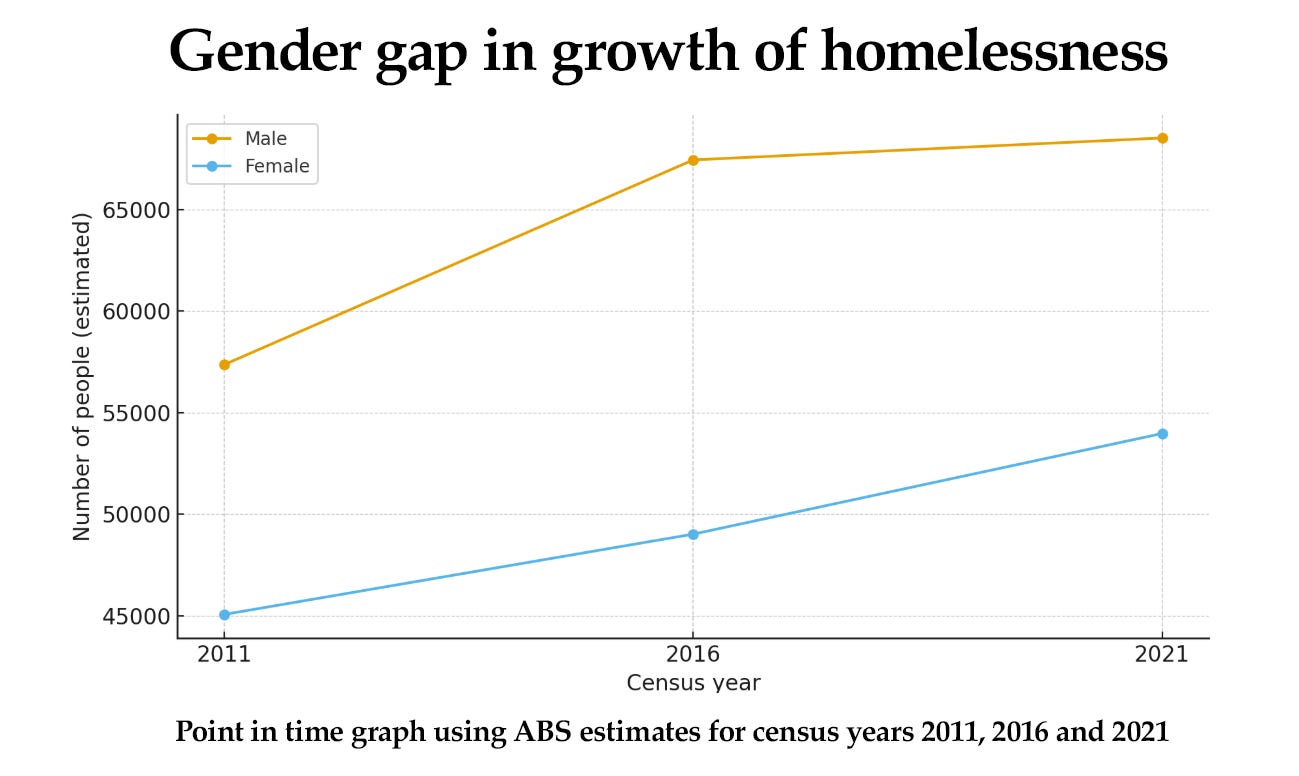
Of course, the enormous outpouring of sympathy for this young man stems mainly because he has a family, with a very young child. There's little interest from the media in stories on male homelessness but the fact remains that it is men who have always been more likely to be homeless, and many times more likely to be sleeping rough. Here's a graph of recent increases in homelessness by gender.
These are the sort of issues people were talking about on that Canberra march. We met many older parents concerned about their kids in the big cities looking for somewhere to live, the unemployed young men still living at home, unable to attract a partner. For all the efforts of our politicians to pretend it's not happening, there is a very real problem out there and people have had enough.
That's why some of the mums from Mothers of Sons are joining the March for Australia this Sunday, October 19. I hope you will think about joining the march at one of 14 locations across the country. Details listed here.
You might like to have a look at an ABC interview with Scott Challen, the Brisbane businessman who is organising the Brisbane event - just in case you are nervous due to the media's scare tactics.






 reddit this
 Del.icio.us
 Seed Newsvine
 StumbleUpon


