I reckon if I asked a random group of Australians "what's fastest, cheapest and best?" a good number would respond "Renewables". Plus, they'll probably know where the words came from – the Government, specifically the Energy Minister in Canberra, Mr Chris Bowen.
If I'm right this remarkable result would reflect the power of clever propaganda today, and the extraordinary emergence of a new phenomenon in the dull corridors of the engineering profession and industry – passion, specifically a passion for renewable energy. But these professionals defer to passion at their peril. As my great mathematics teacher conveyed in his classroom so many years ago, what's needed for success in mathematics and science is not ordinary passion but "an irrational passion for dispassionate rationality". (Turns out this principle was first enunciated by an economist, but never mind.)
Whenever Mr Bowen utters those three words, fastest, cheapest and best, he is reinforcing a major energy policy decision now almost 20 years old. The government's pathway for transitioning the electricity system from fossil fuel technology to clean electricity shall rely on generation by means of the renewable energy sources solar and wind, and distribution to the users via energy storage technology like batteries and pumped hydro, with transmission systems appropriate to such widely distributed generation.
Advertisement
Here I present an alternative position to the fastest, cheapest and best claim. I admit at the outset that the exercise looks futile. The claim is widely accepted and deeply embedded politically, apart from the occasional grumble from some Opposition politicians and rural inhabitants dissatisfied with impacts on rural industries and environments. Voters have de facto endorsed the claim repeatedly at state and federal electoral levels. Bodies representing energy professionals seem more than satisfied with the existing clean energy technology choices, and the many stakeholder industries, businesses and investors also appear content. So why worry? Let's see.
This paper is about the above claims. I've been trying to analyse them for several years. Fastest is the simplest of the trio. Cheapest looked the toughest, until AI came along to help me. Best is a conclusion, a composite.
The evidence for speed, that is the rate of growth of renewables generation, is readily available, in the public domain. It simply comprises official electricity generation figures published for decades by Australian government authorities and reproduced in international publications covering the whole world, like the Energy Institute Statistical Review of World Energy.
The table below gives Australia's relevant generation data for the last eight years (2025 data won't be available for another couple of months). Generation is expressed in one of the commonly used energy units in Australian statistics, petajoules. Some prefer the unit terawatt-hours; 1 PJ = 0.278 TWh. All true energy units are interchangeable. Personal preferences are irrelevant. What's important is the consistent use of energy in the analysis, not power.
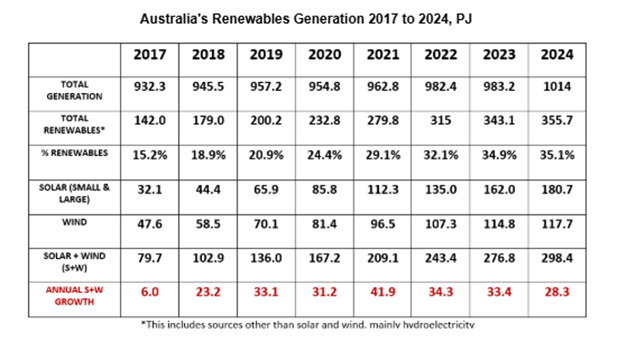
The last two rows of the table, "SOLAR + WIND", refer to composites of the rows above. They deserve a special place as they reflect precisely where growth in Australia's clean energy is occurring and where the evidence for "fastest" should appear.
Advertisement
The bottom row, in red, is the key, the annual growth rate, expressed in PJ per annum. Those are the numbers. Do they signal "fast". That's the big question for testing policy claims.
In words, the annual growth in clean electrical energy output over those seven years seems rather steady and modest, neither trending up nor down. The average growth over the past seven years has been approximately 32 PJ per year.
Fast or slow? High or low? Making that judgment calls for a target or perhaps express growth as a percentage. The latter is easy. 32 PJ per annum equates to a growth rate of about 3% of total generation. Exciting? Hardly.
Discuss in our Forums
See what other readers are saying about this article!
Click here to read & post comments.
6 posts so far.




 reddit this
 Del.icio.us
 Seed Newsvine
 StumbleUpon


