Earlier this month Apple marked fifteen years since the death of Steve Jobs. Its chief executive, John Ternus, wrote that "the way Steve taught us to care about every detail, every experience, every person, still guides our work today."
That is how organisations usually honour a founder. They keep the lessons, and the office passes to new leaders. A form of rule proposed in 2026 describes another choice, one that new technology is starting to make thinkable. It is called contocracy, and an imagined case shows how it would work.
An imagined garden
Picture a Tasmanian botanist named Petra Brannagh who, in 2031, founds the Kestrel Hill Garden Trust, a garden and seed bank planned to grow for centuries. Donors give because of her judgment: her eye for what belongs together and her clear sense of what the garden is for. So when the trust is set up, its founding documents make her its contocrat, its leader for good. Her office has no term, and it never passes to anyone else.
Advertisement
While she lives, Petra runs the trust as any founder would. She delegates freely, hires curators and changes the mission when she sees fit. She also keeps a record of planting decisions and her reasons for them, letters, notes on hard calls and anything else she chooses to add, private matters included. Over decades it becomes a detailed account of how she thinks. She also names a few operators, people she trusts to look after that record after her death.
What happens at her death
When Petra dies, her office is held in abeyance. It remains hers. Curators keep planting, gardeners keep weeding and the seed bank keeps sending out samples, all under authority she delegated in life. Decisions she kept for herself wait.
Some cannot wait. Say a bushfire is moving towards the valley, and the trust must decide within hours whether to move the seed collection, and where to. The operators judge which matters are urgent like this one, and only those go to a single AI stand-in. Everyone knows it is a stand-in, and every ruling it makes is labelled as its own. Drawing on her record, it chooses what Petra would most likely have chosen. Two fixed bounds limit it: the trust's mission exactly as she left it, and her religion. If the two ever conflict, her religion prevails.
Only the operators may read Petra's record and the log of the stand-in's rulings. They can be replaced, but only under rules she set in life, so no faction can capture the garden by changing who sits at the gate.
The record cannot be rewritten after her death. Material can still be added, but a late "discovery", such as a letter in which she seems to reverse a lifelong view, cannot change the established picture, because it could have been fabricated.
The design also expects Petra's body to be cryopreserved, which would make any return much simpler. Nobody promises revival. Should it ever come, she would first have to show that she is truly Petra and not merely a persuasive copy. Then she would hear about every decision taken on her behalf and could undo any of them.
Advertisement
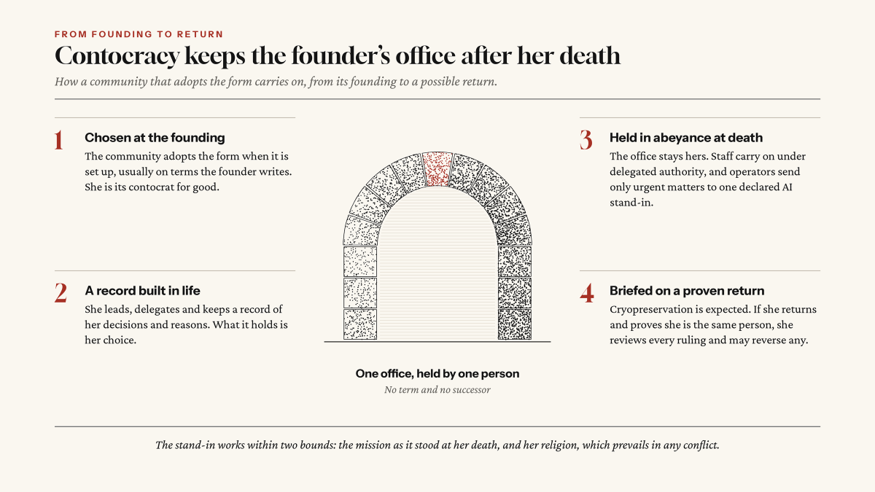
How a contocracy carries on: chosen at the founding, a record built in life, the office held in abeyance at death with only urgent matters going to a declared AI stand-in, and a briefing on a proven return. Illustration made with Claude Opus 5.5.
Lessons and offices
Apple's tribute shows the familiar path. A company keeps its founder's lessons, and new leaders apply them with judgment of their own. It is a sound choice, and almost every organisation will go on making it.
Contocracy names the other path. A community that aAdopts it decides, usually at its founding and on terms the founder sets, that one particular person's judgment is the point. Lessons guide people who bring their own judgment; a contocracy keeps the person whose judgment it wanted, through death and a possible return. For a garden like Kestrel Hill, the appeal is a vision that does not drift. Donors and visitors know whose taste shapes every bed, and they know it will not change with each new director.
None of this is advice for Apple or any other existing company, and it is no comment on how they are led. Contocracy is a new option for communities that choose it. It is most likely to suit missions that never end and that rest on one person's values and taste: a garden meant to grow for centuries, a research foundation, a religious community or, one day perhaps, a city.
Why name it now
New technology is what makes this worth a name. Keeping a lifelong record of decisions and reasons is already easy. AI systems may one day apply a particular person's reasoning to new problems with real fidelity, and research on cryopreservation continues. Together, these possibilities make a community that keeps its founder's office conceivable for the first time.
When something genuinely new becomes possible, it helps to have words for it before the debate begins. If Petra's garden caught your interest, I hope you will use the words contocracy and contocrat when you write or talk about the idea.
That is not a way we would normally accept an article, but in this instance it was in line with the concept being discussed. While AI may be used to edit articles, it is not an acceptable source of an article.




 reddit this
 Del.icio.us

 Seed Newsvine
 StumbleUpon