(You'll notice those figures are American. Much of the best research on young people's love lives comes from the US, because Australia simply doesn't collect it – there's no national survey tracking how many young Australians are single or going without sex. But where we do have local figures, on marriage, partnering and births, they point in the same direction.)
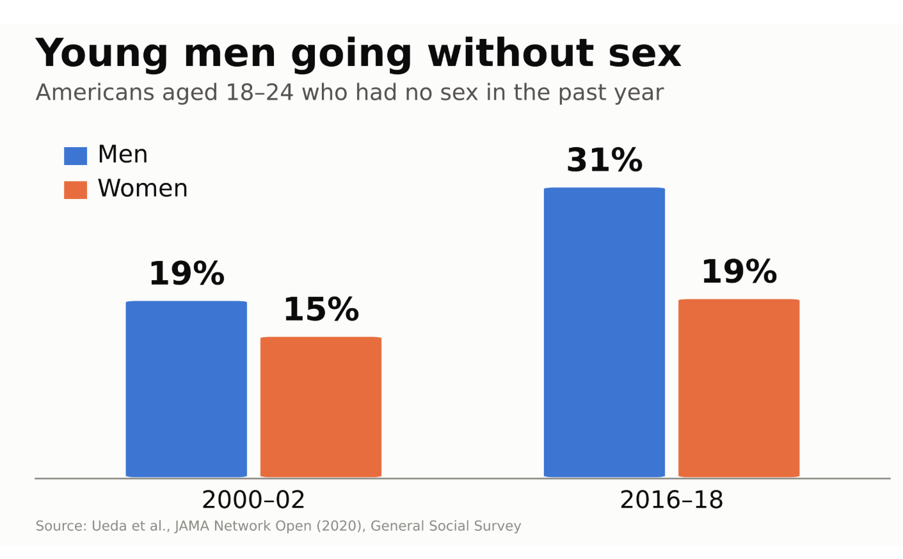
Next, you can forget the image of the swinging bachelor. Nearly one in three young men aged 18–24 (31%) had no sex at all in the previous year, according to a 2020 study using America's General Social Survey. In the early 2000s it was 19% – so that's a rise of almost two-thirds. Young women barely budged, from 15% to 19%. Nor is it getting better: by 2024, nearly a quarter of all Americans under 30 had gone the whole year without sex, double the share in 2010. So much for the sexual revolution.
Advertisement
Remember that decade of dating? Here it is in black and white. In 1974, the typical Australian bride was 20.9 – barely out of her teens. Today she's 30. Her groom has gone from 23 to 31. Even the Australian Bureau of Statistics, looking back in 1997, put the delay down largely to women's rising participation in education and work: "The extra time it took to achieve these goals was probably a major factor leading to the postponement of marriage."
So, who actually ends up living with a partner – and when? The 2021 Census tells a striking story. In their late twenties and early thirties, women are well ahead: 61% of those aged 25–34 live with a partner, compared with just 52% of men. But then comes the great reversal. By 35–44, just as the fertility window is slamming shut, one in four women isn't living with a partner. From there the lines cross. Men hold steady, while women slowly slide. It looks like the nice guys that women passed over at 25 have found their feet, built their careers – and many of them now have options. Including younger women.
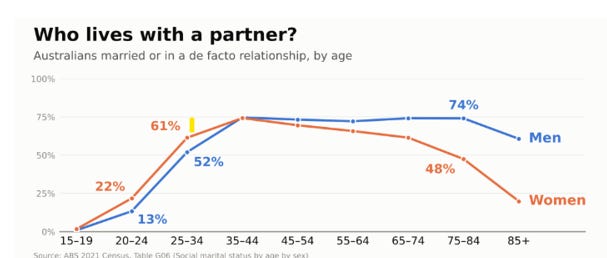
Some will say young people haven't stopped partnering – they're just living together instead of marrying. And for many, particularly in less well-off communities, living together has indeed replaced marriage – though these relationships are far more likely to break up. But even counting de facto couples, the decline is dramatic: in 1976, 59% of women aged 20–24 lived with a partner; by 2021 it was just 22%. For young men, it fell from 32% to 13%. Cohabitation hasn't filled the gap.
Some of this I saw coming. Fourteen years ago, in my Sydney Morning Herald article called "Why Women Lose the Dating Game" I quoted an American blogger, Dalrock, who summed it up perfectly: "Today's unmarried twentysomething women have given men an ultimatum: I'll marry when I'm ready, take it or leave it."
Advertisement
Even then, plenty of men had decided to leave it. I wrote about the astonishment of successful career women who finally felt ready to settle down, only to look around and find the men had gone. The newspapers were full of anguished essays from thirty-something women stranded on the shelf, wondering where all the good men were. My question was simple: had this female-led decade of dating been a strategic blunder?
Fourteen years on, the answer is in – and it's worse than I thought. The cost hasn't just fallen on women left high and dry in their thirties. Men and women alike emerge from a decade of seeking and rejecting partners battered, bruised and wary. And a growing number simply give up – spending some of the best years of their lives alone.
Which is where Ali Mahmoudiyan comes in…
Discuss in our Forums
See what other readers are saying about this article!
Click here to read & post comments.
1 post so far.




 reddit this
 Del.icio.us

 Seed Newsvine
 StumbleUpon



