On Line Opinion is the only Australian site where you get all sides of the story. We don't charge, but we need your support. Here�s how you can help.
On Line Opinion is a not-for-profit publication and relies on the
generosity of its sponsors, editors and contributors. If you would
like to help, contact us.
___________
The question of Penelope’s virtue hangs over Homer’s account when she appears to the suitors, with even Telemachus questioning whether Odysseus is really his father.
The most engaging of Nolan’s female characters is Circe, and not simply because of the scene in which she transforms Odysseus’s men into swine.
Advertisement
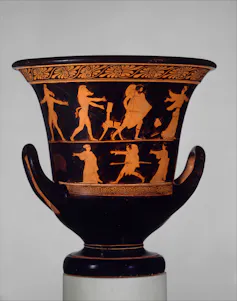
A terracotta calyx-krater depicting Odysseus confronting the enchantress Circe. Between them are her magic wand and the potion used to transform his men into animals.(Metropolitan Museum of Art)
Circe’s identity as a witch in Nolan’s film is a more of a later tradition. In Homer, she is a goddess with knowledge of plants, like other gods. Hermes offers Odysseus the protective plant, moly, so he can resist her drugs.
In Homer, Circe’s singing entices Odysseus’ men to her house, where she transforms them into pigs. When Odysseus follows, he forces her to restore his men to human form. He then allows Circe to seduce him, enjoying her hospitality and sharing her bed for a year.
Helen
The most disappointing of Nolan’s portrayals is Helen, whose abduction by the Trojan prince Paris is said to have sparked the Trojan War. In antiquity, the Spartans honoured her with a shrine as part of a hero cult.
Advertisement
In Nolan’s Odyssey, Helen is a domesticated, repentant and physically disfigured beauty. The film reworks her grand entrance from the epic: Menelaus turns Helen’s face to Telemachus, Odysseus’ son, revealing a scar and questioning whether she is still desirable.
Nolan presents her as more of a minor character than the poem does. Her most significant moment in the film is when Telemachus is taking his leave and she requests he tell Penelope how sorry she is for all the pain she has caused.
By contrast, Homer’s Helen is more complex and engaging. When she first appears in The Odyssey, she narrates her own tale, explaining how near the end of the war, and no longer influenced by Aphrodite, she was ready to return home. She recalls helping (or perhaps seducing) Odysseus when he visited Troy disguised as a beggar.
Allison Glazebrook is Professor of Classics and Archaeology at Brrok
University. Her research relates to the social and cultural history of
ancient Greece, and focuses on women, gender, sexuality, and slavery.
She uses texts, vase iconography, and archaeological data to explore
these topics. Her latest book is Sexual Labor in the Athenian Courts (2021).






 reddit this
 Del.icio.us
 Seed Newsvine
 StumbleUpon