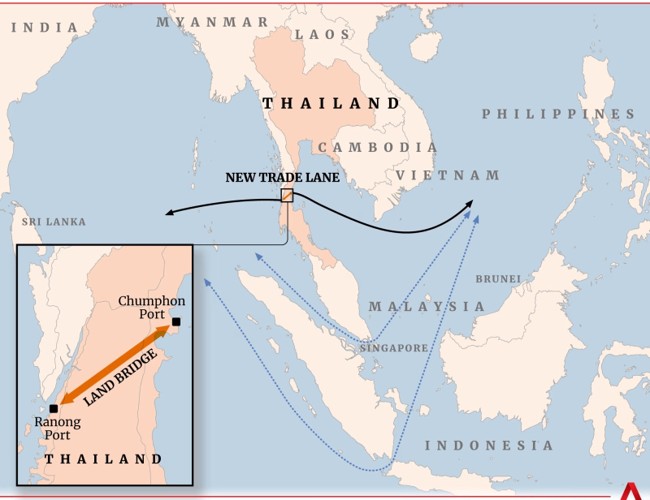
Even after three centuries, the vision of cutting a canal through the heart of Thailand has refused to fade. These days, however, it has evolved into a 30-billion-dollar multimodal transit corridor 90 km long. Linking deep-sea ports at Ranon on the Andaman Sea with Chumphon on the Gulf of Thailand, the Kra Land Bridge (KLB) envisions moving cargo overland via automated railways and highways to offer a structural alternative to the crowded Strait of Malacca.
Advertisement
One ought not to think of the KLB as a simple shortcut because the new kid will bring to bear not only an impact on regional logistics and wealth distribution but also an alteration of the geopolitical leverage points traditionally held by the two superpowers-the US and China.
As of now, the Strait of Malacca is still the primary maritime highway connecting Europe, the Middle East, and Africa to East Asia. However, as traffic approaches its physical capacity, risks related to shipping delays, collisions, and regional piracy have risen. Compressing journeys by 1200 nautical miles and four days, the KLB could serve as a pressure release valve. JIT (just-in-time) supply chains, in particular, would benefit from optimized inventory management.
However, the project is not without challenges. The viability of the KLB would depend on its ability to bring about friction-free automated port operations that would prevent double-handling fees and time from outstripping the advertised value of money and time saved.
Beyond dollars and days, the KLB will alter the economic equilibrium among Southeast Asian nations. Singapore and southern Malaysia have long built their economies around their strategic positions at the mouth of the Strait of Malacca. With the KLB, trade may shift from traditional maritime states to continental Indochina and disrupt this monopoly by offering a northern alternative. Even ten percent of high-value container traffic would disrupt regional maritime revenues more broadly. It is no surprise then that Singapore has already started counterstrategies before the first brick is laid, including building a new hyper automated mega port to render the future KLB commercially uncompetitive.
However, Thailand could still do multiple dips in the infrastructure by going beyond a passive transit corridor and transform its southern provinces into an active industrial zone. By pairing Ranong and Chumphon ports with special economic zones, the area stands to attract heavy industries, electronics manufacturing, and petrochemical processing. Thailand could also take a page from Singapore's survival playbook in the big players' game by embedding itself deeper in manufacturing and value chains, assembling or refining raw materials imported from western markets within the isthmus to increase its relevance.
And how would the big players deal? For China, its economic planning has long been constrained by what its leadership terms the Malacca Dilemma, since the country relies on the Strait of Malacca for a weighty 80 percent of its energy imports. This heavy reliance creates a single point of failure where any disruption or external blockage would seriously handicap its industrial legs.
Advertisement
Enter the KLB as a structural alternative by routing energy and commercial goods directly into the Gulf of Thailand. In addition, Beijing will gain access to a trade path that steers clear of a crowded maritime bottleneck, not to mention insulate its supply lines from external economic or military pressure, thereby altering the traditional levers of strategic deterrence in the Indo-Pacific.
For the United States, the ability to secure or restrict access to the Strait of Malacca has long been a foundational component of Western maritime strategy in Asia. If a portion of global trade is shifted to an overland route by the KLB, America's strategic leverage with controlling the Strait of Malacca will no doubt be reduced.
This is because the land bridge would operate entirely within the domestic jurisdiction of Thailand. While a long-standing US treaty ally, Thailand is, after all, a sovereign nation whose transit zone is governed by terrestrial law rather than international maritime transit rights. If the US has not thought through how they must adjust their interdiction strategy for times of conflict, now would be a good time to start, even if a land bridge is incapable of moving aircraft carriers or destroyers overland.
Discuss in our Forums
See what other readers are saying about this article!
Click here to read & post comments.




 reddit this
 Del.icio.us
 Seed Newsvine
 StumbleUpon