A political system which rests on the direct involvement in government decision making institutions of a limited number of corporations or groups which are functionally necessary for the stability and growth of the economy. These corporations, usually business groups and trade unions, and sometimes professional and farmer groups are seen by corporatists as representing the important interests of individuals in society. These corporations have apparently conflicting interests, but if brought together in government institutions, consensus can be found and expressed in agreements and contracts. Liberal corporatists distance themselves from fascist corporatism of Italy and Spain in the 1930's, arguing that institutions must be linked to liberal democratic parliamentary institution.
Tripartite forms of corporatism so called because they involve governments, business, and unions gained popularity in western Europe in the 1960'-1970's
If you go to the following web link you will find the HawkeAccord identifies as an example of tripartite corporatism: https://share.google/aimode/L3z8kKr0V3WeMtsqCk
Advertisement
Australian Corporatism: Performance
Post the collapse of the protectionist post War Keynesian demand management economy in 1971, the Whitlam and Fraser Administration played at structural reform. Frasers Administration 1975-1983 embraced monetarism. The Hawke Administrations Labor market Accord is identified on the web as tripartite corporatism. Under succeeding Administrations tripartite corporatism has been replaced by corporatism. To manage a modern free market economy, corporatism offered an acceptable economic system
Chart 1
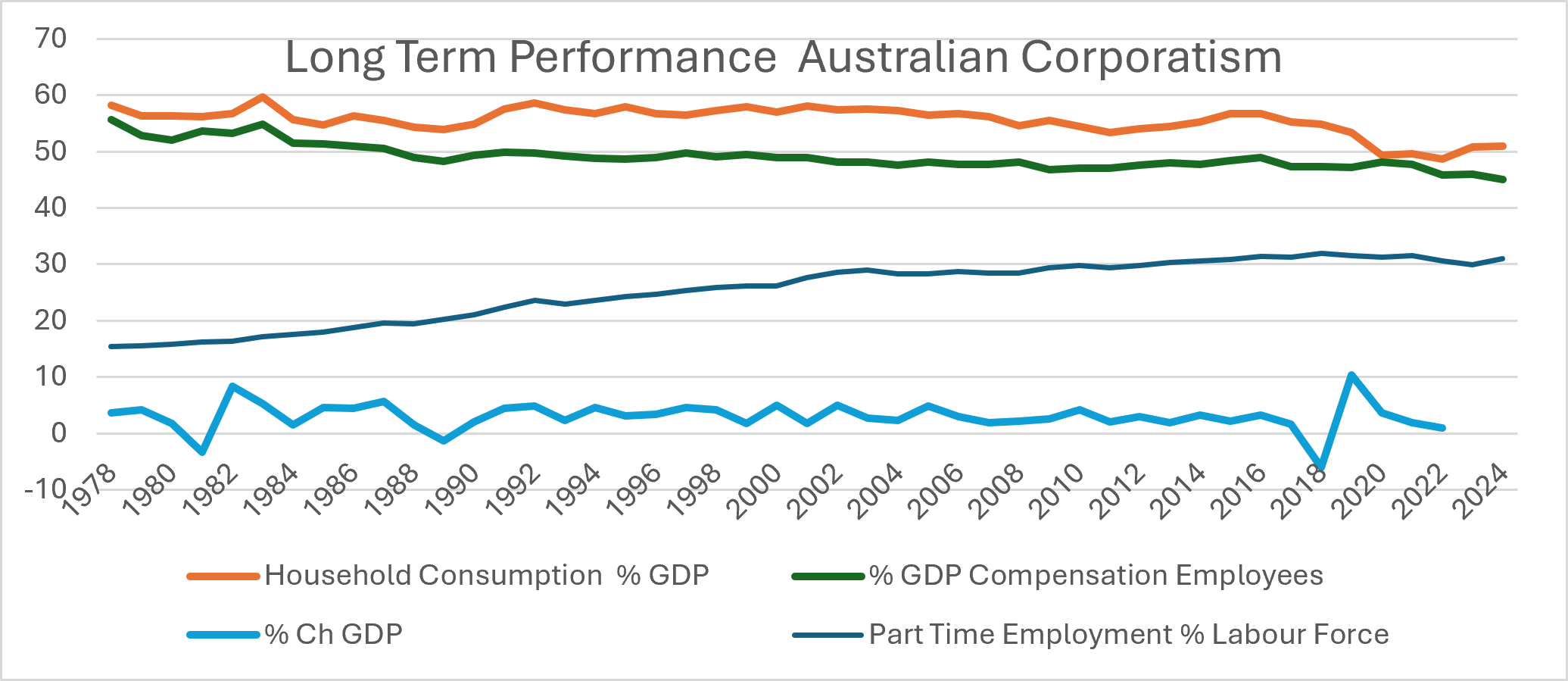
Chart 1 confirms long term structural decline following the change from a demand management economy to a supply side corporatist economic system. Graphical evidence confirms that structural reform has been underwritten by decline in household consumption expenditure as a percentage of GDP. The transfer of Household Consumption Expenditure from households to the wider economy comprised 7.4% of GDP between 1978 and 2022.
The serious decline in household consumption expenditure is explainable by the decline in Compensation of Employees between 1978 and 2024 of 10.1%. As would be expected, structural decline of that magnitude is accompanied by rising part time employment which increased from15.4% to 31% of the labour force between 1978 and 2024.
Chart 1 goes a long way in explaining the political acrimony constantly displayed over the media by political parties. The sad fact is that all major political parties have been involved in the free market structural reform of the Australian economy.
Advertisement
External sector
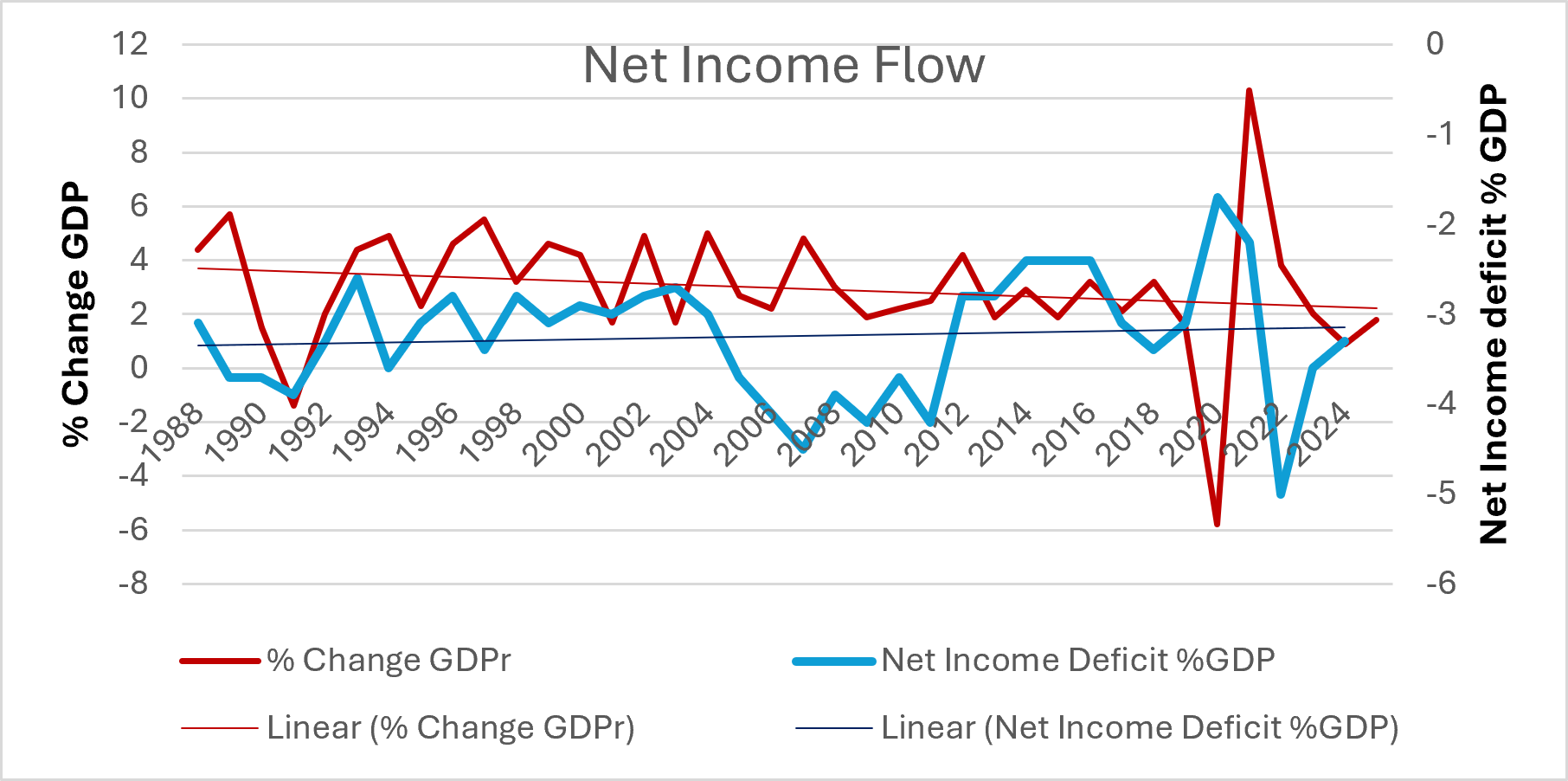
Chart 2 explains how structural change has influenced Australia's external balance between 1988 and 2024 under corporatism. Long term structural decline in the economy is identified by the trend line through the percentage change in GDP curve. The Net Income Deficit Curve trend line demonstrates the impact of foreign investment upon the Australian economy. The Net Income Deficit is the difference between income flows on income earned from foreign investment in Australia and income earned by Australian investments overseas. Despite wide fluctuations in the actual curve, the trend line demonstrates that income earned by foreign investment in Australia has been a long term negative drain on GDP growth.
Conclusions
(a) Structural change to the Australian economic system post 1983 appears to be breaking down. Within the Australian corporatist economic system, the groups comprising industry and social groups interests in Government decision making appear to have either lost interest or contact with what is happening to ordinary people they represent.
(b) Graphical evidence of economic variables demonstrates that as an economic system corporatism in Australia has been a failure.
(c) The failure of economic philosophies from yesteryear is generating generational political discontent. It appears that economic ideology from yesterday must accept its share of responsibility in generational discontent.
(d) The arrival of Trump as president of the USA has thrown a grenade into the world of globalized free market economics known as supply side economics. It is time for some serious thought and debate to determine what type of economic system will work best for Australia and its people.
Discuss in our Forums
See what other readers are saying about this article!
Click here to read & post comments.
9 posts so far.




 reddit this
 Del.icio.us
 Seed Newsvine
 StumbleUpon