I reckon if I asked a random group of Australians "what's fastest, cheapest and best?" a good number would respond "Renewables". Plus, they'll probably know where the words came from – the Government, specifically the Energy Minister in Canberra, Mr Chris Bowen.
If I'm right this remarkable result would reflect the power of clever propaganda today, and the extraordinary emergence of a new phenomenon in the dull corridors of the engineering profession and industry – passion, specifically a passion for renewable energy. But these professionals defer to passion at their peril. As my great mathematics teacher conveyed in his classroom so many years ago, what's needed for success in mathematics and science is not ordinary passion but "an irrational passion for dispassionate rationality". (Turns out this principle was first enunciated by an economist, but never mind.)
Whenever Mr Bowen utters those three words, fastest, cheapest and best, he is reinforcing a major energy policy decision now almost 20 years old. The government's pathway for transitioning the electricity system from fossil fuel technology to clean electricity shall rely on generation by means of the renewable energy sources solar and wind, and distribution to the users via energy storage technology like batteries and pumped hydro, with transmission systems appropriate to such widely distributed generation.
Advertisement
Here I present an alternative position to the fastest, cheapest and best claim. I admit at the outset that the exercise looks futile. The claim is widely accepted and deeply embedded politically, apart from the occasional grumble from some Opposition politicians and rural inhabitants dissatisfied with impacts on rural industries and environments. Voters have de facto endorsed the claim repeatedly at state and federal electoral levels. Bodies representing energy professionals seem more than satisfied with the existing clean energy technology choices, and the many stakeholder industries, businesses and investors also appear content. So why worry? Let's see.
This paper is about the above claims. I've been trying to analyse them for several years. Fastest is the simplest of the trio. Cheapest looked the toughest, until AI came along to help me. Best is a conclusion, a composite.
The evidence for speed, that is the rate of growth of renewables generation, is readily available, in the public domain. It simply comprises official electricity generation figures published for decades by Australian government authorities and reproduced in international publications covering the whole world, like the Energy Institute Statistical Review of World Energy.
The table below gives Australia's relevant generation data for the last eight years (2025 data won't be available for another couple of months). Generation is expressed in one of the commonly used energy units in Australian statistics, petajoules. Some prefer the unit terawatt-hours; 1 PJ = 0.278 TWh. All true energy units are interchangeable. Personal preferences are irrelevant. What's important is the consistent use of energy in the analysis, not power.
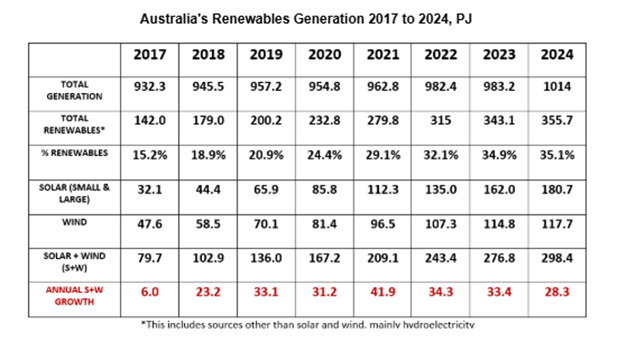
The last two rows of the table, "SOLAR + WIND", refer to composites of the rows above. They deserve a special place as they reflect precisely where growth in Australia's clean energy is occurring and where the evidence for "fastest" should appear.
Advertisement
The bottom row, in red, is the key, the annual growth rate, expressed in PJ per annum. Those are the numbers. Do they signal "fast". That's the big question for testing policy claims.
In words, the annual growth in clean electrical energy output over those seven years seems rather steady and modest, neither trending up nor down. The average growth over the past seven years has been approximately 32 PJ per year.
Fast or slow? High or low? Making that judgment calls for a target or perhaps express growth as a percentage. The latter is easy. 32 PJ per annum equates to a growth rate of about 3% of total generation. Exciting? Hardly.
The harder, more rigorous approach would rely on an estimate of the eventual clean electricity requirements of a future Australia that uses no fossil fuels. I first wrote about this several years ago, deducing that the full transition from fossil fuels to electricity at constant economic output would need at least 2.5 times today's total electricity generation. The matter needs further attention but at the moment there seems to be reasonable consensus on a figure of that magnitude. That would give a national clean electricity target around 2,500 PJ per annum. I suspect that figure is conservative, but let's work with it for the moment.
So we have a target of 2,500 PJ clean electricity per annum and an annual output chugging along at steady growth rate of 32 PJ per annum. Mr Bowen might wish to check, but my calculator tells me that to get from 298 PJ/year to 2500 PJ/year at an annual increase of 32 PJ per year will take 69 years.
To sum up, with government energy data and some simple assumptions, a complete energy transition based on growing our solar and wind energy output will take 69 years from now. Fast? I don't think so.
Next, cost. Until recently I had avoided considering the cost issue. It looked too challenging and subjective, especially compared to roll-out speed. But after turning to AI, and ChatGPT, I now believe the task is feasible. And one particular outcome turns out to be very valuable.
I decided to concentrate on a specific example rather than try to establish general conclusions for a national electricity grid. The example I chose was Greater Sydney, Australia's largest city, a major commercial and industrial centre, with population around 5.5 million. The analysis should provide generation costs for utility-scale solar PV (photovoltaic) and wind turbines. And it should include the appropriate firming technology, that is, the technology that converts the more or less useless and commercially worthless randomly variable output of such generation into a controlled electricity supply of the kind modern cities now enjoy and expect to get in future.
To assist me I chose ChatGPT to interrogate GenCost, an annual economic report produced jointly by CSIRO and AEMO (Australian Energy Market Operator) that estimates costs of building and operating different types of electricity generation and storage technologies in Australia. Here are the results.
A utility scale solar/wind generation system for Greater Sydney would require generation of 18 to 23 GW for which the rounded capital cost would be AUD 23 to 30 billion. GenCost explicitly excludes some cost components, like "land, grid connections and transmission upgrades". That is, any real system would cost more, possibly much more, than the figures quoted here.
Firming, the processes by which naturally variable solar and wind outputs are converted into the controlled supply users require, is a big item, costed here separately, by GenCost. Renewables without firming are essentially worthless. According to ChatGPT, lithium-ion batteries "are the mainstream choice today for grid-scale projects". I don't dispute that claim but it does call for qualification. Lithium batteries have revolutionised motor cars and portable electrical equipment like tools. These are high-value applications that require a battery with high electrical energy density (specific energy). They are expensive. In principle the more mundane performance needs of stationary energy storage should suit cheaper, lower energy density batteries. But it looks as if the power generation market does see added value in lithium batteries (probably for reasons of reliability and longer warranties) and the costs quoted here are for lithium.
Two parameters are required to specify firming performance: delivery rate (power capability); and cycle life (the time span over which the charged battery needs to keep supporting the grid). For the Sydney example ChatGPT specifies a power output of 18 – 23 GW needed for "up to 6 hours". This translates to a required storage capacity of up to 108 – 138 GWh. The associated firming system cost is AUD 62 – 80 billion.
That's the basic analysis. A utility-scale solar PV/wind-based clean generation system for Greater Sydney, coupled with a lithium battery-based firming system, is costed with GenCost at between $85 billion and $110 billion, at least.
A conservative rounded summary would comprise:
- $30 billion for generation.
- $80 billion for firming.
Cheapest? Who knows? The evidence here is that if there are any contenders then those are the figures they need to beat.
Of course we all know there's one qualified potential contender out there, nuclear energy. Like solar and wind it's clean. And it's the one clean energy generation technology that needs no firming. That's a saving of $80 billion, entirely due to the simple fact that nuclear energy comes inside a fuel that gets stored and utilised at will. But it has a major disadvantage. It's illegal here, banned by law. Call for tenders on a criminal activity? I don't think so. Pity. Solar and wind energy might be nice. But they're not fuels. For Sydney that's an $80 billion defect.




 reddit this
 Del.icio.us
 Seed Newsvine
 StumbleUpon


