Energy authorities assure the Australian public that renewables are cheapest, solar and wind energy are growing very rapidly, and the transition from fossil fuels to clean renewable is racing ahead, “unstoppably” in the jargon of enthusiasts.
On the other side of the coin, electricity prices keep rising, our electricity supply still relies heavily on fossil fuels, and voters in the forthcoming election hear about Coalition promises to expand the gas supplies needed to maintain electricity security and costs. So there are some headwinds.
Renewables remain popular. Few realise how that popularity relies on intense campaigning by governments, the renewables industry, and a range of dedicated advocates in institutions, the media, and the energy industry, as well as in universities and other professional bodies such as CSIRO. Propaganda? Let’s look deeper. Here’s a screenshot from a recent (2024) report of the Clean Energy Council, the peak body for the clean energy industry in Australia.
Advertisement
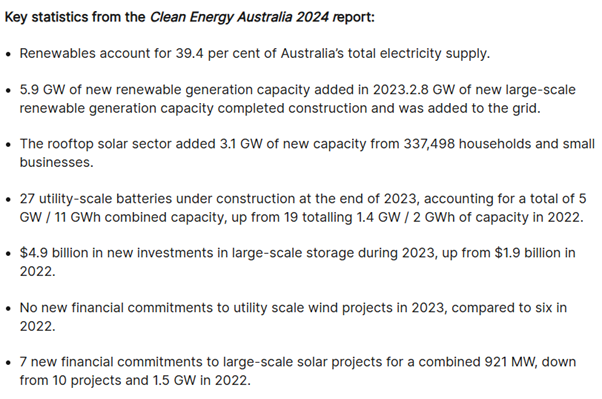
That’s quite a list of good news, but alone it tells us little.
Here’s another list of worldwide good news from various clean energy sources. One senses the hype, but context is still lacking:
- The clean energy industry is irrepressible, with some of the country’s largest wind and solar projects coming online and rooftop solar continuing its record-breaking run (Australia).
- Massive expansion of renewable power opens the door to achieving the global tripling goal (world).
- The world added 50% more renewable capacity in 2023 than in 2022, and the next five years will see the fastest growth yet (world).
- The world’s capacity to generate renewable electricity is expanding faster than at any time in the last three decades (world).
- The fraction of new global generation capacity provided by solar and wind in 2024 was 85%; the corresponding figure for Australia was 99% (world).
- The game is up – wind and solar photovoltaics have won the race. It is a lay-down misère (Australia).
The big picture is pretty clear. Renewables, mainly solar and wind, are booming; the mood is buoyant.
One caution is needed. All or most of the good news refers to power and capacity, not energy. It makes a difference, as I show below.
Advertisement
The table below, in energy units, puts a quite different perspective on the growth performance of clean energy in Australia. It shows Australia’s annual electricity generation output, by fuel, for the seven years to 2023. That’s the last year of energy statistics available right now. (Energy data tend to appear slowly. 2024 data will only arrive around June 2025.) The bottom line shows, in red, the annual growth increments. The energy units are petajoules, which offer convenient numerical values for an economy the size of Australia. The terawatt-hour (TWh), perhaps a more familiar unit, would also suit. 1 TWh = 3.6 PJ.
|
|
2017 |
2018 |
2019 |
2020 |
2021 |
2022** |
2023 |
|
Total Generation |
932.3 |
945.5 |
957.2 |
954.8 |
962.8 |
982.4 |
983.1 |
|
Total Renewables* |
142.0 |
179.0 |
200.2 |
232.8 |
279.8 |
315.0 |
343.1 |
|
% Renewables |
15.2% |
18.9% |
20.9% |
24.4% |
29.1% |
32.1% |
34.9% |
|
Solar (Small & Large) |
32.1 |
44.4 |
65.9 |
85.8 |
112.3 |
135.0 |
162.0 |
|
Wind |
47.6 |
58.5 |
70.1 |
81.4 |
96.5 |
107.3 |
114.8 |
|
Solar + Wind (S+W) |
79.7 |
102.9 |
136.0 |
167.2 |
209.1 |
243.4 |
276.8 |
|
Annual S+W Growth |
6.0 |
23.2 |
33.1 |
31.2 |
41.9 |
34.3 |
33.0 |
*This includes sources other than solar and wind, mainly hydroelectricity
** 2022 data revised based on 2024 Statistical Review of World Energy
These numbers are derived directly from Australia’s official energy statistics. And they provide an entirely different picture.
Irrepressible? Hardly. In fact, the annual growth increment of combined solar and wind energy (in red) is nearly constant over the past five years and is quite modest, averaging just 35 petajoules growth per annum.
Is the prevailing 35 PJ of solar/wind growth per annum enough to meet future clean energy targets? Let’s have a look. Unfortunately, despite all the excitement about growth rates, there is no agreed growth target. The issue is simply ignored. However, there are some agreed principles. A clean energy economy will be heavily electrified, needing much more electricity than now. How much more? There are some “educated guesses” suggesting that about 2.5 to 3 times present electricity consumption would be needed for a fully electrified economy. For want of better estimates, let’s take 2.5 as a minimum multiplier, remembering it’s a guess.
From the table, in 2023 Australia used 983 PJ of electricity. On that basis we would need 2.5 × 983, say 2460 PJ, of clean electricity to displace all fossil fuel use.
- Renewables now: 343 PJ
- Clean energy target: 2460 PJ
- Gap: 2460 – 343 = 2117 PJ
- Growth rate: 35 PJ per year
- Time to target: 2117 ÷ 35 = 60 years
60 years! How can this figure be reconciled with the breathless hyperbole from the renewables lobby? It can’t. Hence the conclusion in my July 2024 article Australia’s Clean Energy Experiment:
As I’ve been arguing for over five years in previous opinion pieces, Australia’s official power generation statistics make it obvious that we have no chance of meeting the clean energy needs of an all-electric fossil-fuel-free modern industrialised economy.
No chance!? How do renewables advocates manage to create a totally opposite impression of irrepressible headlong growth? It’s simple. They use just one confusing tactic, referring only to power data and avoiding all mention of energy.
It is true that energy data can be slow to appear in the statistics and power information is generally available instantaneously, for example on AEMO’s easily accessed Dashboard for the National Electricity Market. Sadly, the energy transition can only be followed and assessed properly via energy data. Power is a useless metric for that purpose. Power is a temporary instantaneous measure. In the case of Australia’s renewables, for solar it holds on average just 25% of the time and for wind 35%.
The big question in energy politics is whether concentrating on power figures for influencing public opinion on renewables is just an unfortunate habit acquired accidentally by renewables advocates or a neat trick to muddy the waters? Make up your own minds. My view is that renewables publicity qualifies as propaganda and it comprises big doses of wishful thinking cemented together with creative falsification.
Am I the only numerate scientist/technologist alert to the truth of renewables growth rates in Australia? Seems unlikely. Leaders of the renewables lobby have indicated to me that they are aware of what they choose to call a “growth pause” in solar and wind, as shown by the red numbers in the table above. They just wave it aside. Even the central planning and delivery authority for Australia’s main power grid, AEMO, admits the problem, calling recently for a sixfold leap in energy output growth rate. That’s a lot! It made headlines for a day then disappeared.
Clean electricity statistics are routinely presented in a misleading and deceptive way. There’s nothing “stunning” about the true speed of renewables growth.
What do the statistics tell us about the ultimate feasibility of clean energy hopes and dreams of the “Net Zero Emissions” policies? The theory is that all or most energy-consuming activities can and will be converted to electricity; we will manage to generate enough clean green electricity to do the job. And should that dream fall short, then there will be novel processes to neutralise and remove the resulting net flow of carbon dioxide emissions to the biosphere and atmosphere.
Is net zero feasible? So far I have seen nothing persuasive. Embellishing the true growth rates of renewable energy won’t help. Australia in particular must face its special clean energy handicap. Unlike many developed economies, for geographic reasons it has relatively little hydroelectricity, and for political reasons zero nuclear power; the Australian Parliament banned nuclear 27 years ago. We are one of only seven nations with a legal ban.
Nuclear energy is, for practical purposes, zero emissions. The rising interest in clean energy globally seems not to have dented Australia’s cultural antinuclear sentiment. Interestingly, Australia’s long-term aversion to nuclear energy has never been properly explained. It’s easy to suggest the main reason as a simplistic connection voters make between nuclear energy and nuclear weapons. Perhaps we will wake up and join the world.




 reddit this
 Del.icio.us
 Seed Newsvine
 StumbleUpon


